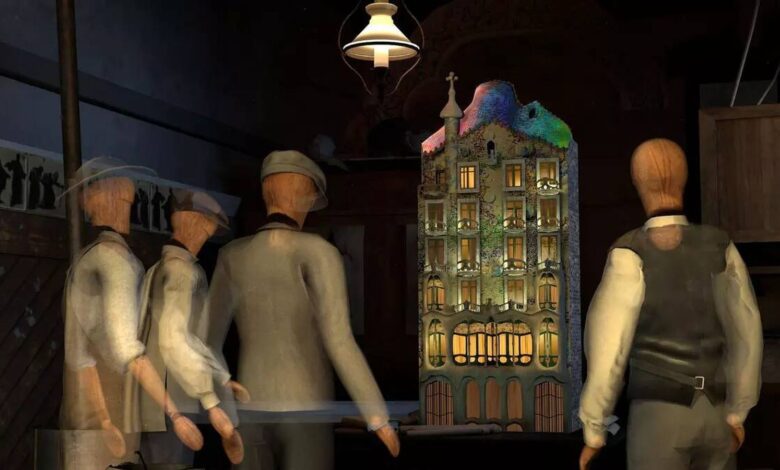
A unique VR exhibition has opened in Barcelona, promising to change the way residents and visitors experience culture in the city. For the first time in the Catalan capital’s history, guests can literally enter the workshop of Antoni Gaudí, where ideas for the Sagrada Familia and other iconic landmarks were born. This event not only broadens opportunities to explore the history of architecture but also highlights the role of new technologies in preserving Spain’s cultural heritage.
The project ‘Gaudí, l’Atelier du divin’, after successful showings at international venues including the prestigious Venice Immersive at the 80th Venice Film Festival, is now available in the very heart of Barcelona — inside the Mercè Hall of the Cathedral. According to El Confidencial, it was here that Gaudí often sought inspiration, lending the event a special atmosphere and historical depth.
A journey into the past
The virtual tour allows visitors to walk through the architect’s workshop, meticulously recreated from archival photographs taken shortly before his death. What makes this especially significant is that most of the original materials were lost in a fire at the onset of the Civil War. Thanks to digital reconstruction, every object, tool, and drawing has been brought back to life, offering guests the chance to literally ‘walk through’ the space where Gaudí worked and even spent his final nights.
The entire exhibition lasts 22 minutes and is accompanied by a brief introductory narration. Modern VR headsets are used for full immersion, with small groups formed to allow each participant to explore the details at their own pace. Seven languages are available, including Spanish, Catalan, English, French, Japanese, Chinese, and Korean. Tickets cost 18 euros, and the schedule is designed to avoid queues: sessions start every half hour from 10 am to 7 pm, and arriving early is recommended.
International Recognition
The project has already received recognition at several international festivals. Among its awards are the Audience Grand Prix at PiXii in France, the prize for Best Cultural VR Exhibition at Stereopsia in Brussels, and the award for Best XR Work at Beyond the Frame in Tokyo. After being shown in countries such as France, Germany, China, and Korea, the VR tour of Gaudí’s workshop has become one of the main events of the Year of Gaudí in Barcelona and will be available until the end of April 2026.
Organizers emphasize that the choice of location is no coincidence: Barcelona Cathedral is closely linked to the architect’s life, and the exhibition itself is housed in a hall usually closed to the public. This adds exclusivity to the event and offers a new perspective on Gaudí’s work.
New Formats for Cultural Spaces
In recent years, interest in using virtual reality to preserve and promote cultural heritage has grown in Spain and around the world. Similar projects have already been implemented in museums in Madrid and Seville, where VR technologies helped attract new audiences and make art more accessible. In Barcelona, this format is being used for the first time on such a scale and with such historical accuracy.
According to El Confidencial, the VR exhibition at the Barcelona Cathedral could serve as an example for other cities where historical monuments require a new approach to their presentation. In the coming years, similar initiatives are expected to appear in Valencia and Zaragoza, confirming the trend of integrating digital technologies into the cultural sector.
In 2025, a project for a virtual visit to the workshop of artist Francisco Goya was carried out in Madrid, while Seville hosted a VR tour of the halls of the Alcázar. Both events generated significant public interest and received positive feedback from experts. Such initiatives not only bring art closer to people, but also contribute to the development of domestic tourism, which is especially relevant for Spain amid increasing competition in the cultural services market.