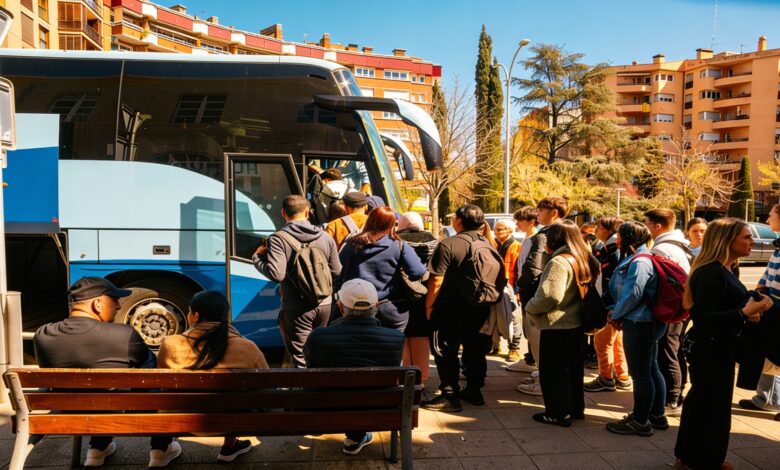
The situation on the R3 railway line in Catalonia has become one of the most talked-about topics among local residents. Years of ongoing repairs and constant disruptions have left this once-popular mode of transport almost unused. For many Spaniards, this means not only lost time but also additional challenges in daily life, especially for those who commute to work or study every day.
As noted by El Pais, La Garriga station (Barcelona) has become the new starting point for R3 trains following the partial restoration of service. However, despite the resumption of the route between La Garriga and Ripoll (Girona), there are hardly any passengers here. Most people prefer free buses, which have become the usual means of getting around as the track doubling works drag on. Local café owners and station staff admit they are surviving thanks only to Renfe employees, not actual passengers.
Transfer issues
For those traveling from Barcelona, the journey on the R3 line now starts with a bus transfer at Fabra i Puig. The bus takes passengers to La Garriga, but there is at least a half-hour wait between the bus’s arrival and the train’s departure. The reason is the inconvenient location of the stop and the need to walk almost half a kilometer. Even after trains resumed, many still rely on the buses, considering them more reliable and faster despite the numerous stops in each town.
Passengers note that traveling by bus takes almost twice as long as by car, while the train ride takes about forty minutes. However, due to constant speed restrictions and technical failures, the train is often delayed, with unexpected stops and disruptions in lighting during the journey. Some passengers admit that traveling by train makes them anxious because of the route’s instability and lack of clear schedule information.
The only single-track line
The R3 line remains the only one in Catalonia where most of the route runs on a single track. This adds more complications: trains have to wait for each other at stations, and a delay for one train causes disruptions along the entire line. As a result, even after service is partially restored, carriages remain nearly empty, and passengers opt for alternative modes of transportation.
Between La Garriga and Vic, as well as from Vic to Ripoll, buses stop in every settlement, which extends the travel time to an hour or more. Passenger numbers on the train increase only at Vic, but by the time it reaches the final station in Ripoll, no more than ten people remain. Most of them are those for whom the bus is not a convenient alternative. The rest choose faster and more predictable routes.
Prolonged works and their consequences
According to El Pais, repair work on the R3 line has been ongoing for more than two years and will not be completed before January 2027. This is one of the longest railway service interruptions in the region’s history. During this time, residents have become accustomed to the inconvenience, and many have stopped relying on the railway as a dependable form of transportation.
Travel time comparisons across different modes of transport do not favor the train: the journey takes about an hour and a half by car, but nearly three hours by train. This is compounded by unreliable schedules, frequent technical breakdowns, and a lack of information for passengers. As a result, the R3 line has become an almost deserted route, with trains running mostly for the few remaining users.
In recent years, similar situations have occurred on other railway lines in Spain. For example, prolonged work on routes in Andalucía and Valencia also led many passengers to switch to buses and private vehicles. In some instances, restoring trust in the railway took years, and the economic impact was felt not only in the transport sector but also among small businesses tied to servicing stations and passengers.