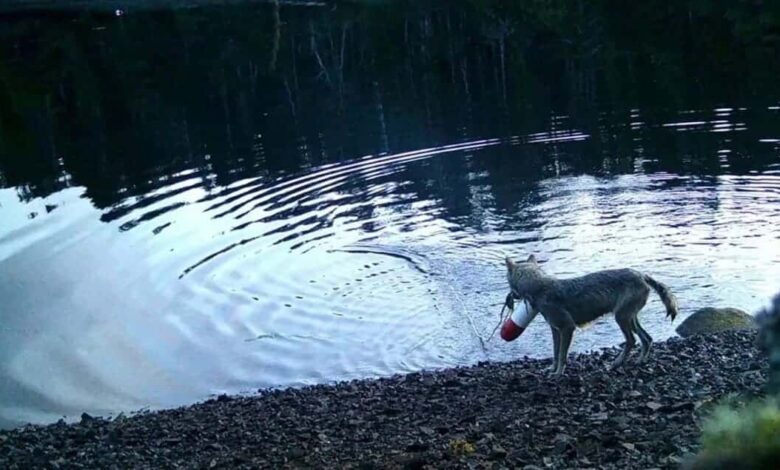
In a coastal district of British Columbia, local residents noticed fish disappearing from their nets. After numerous complaints, experts installed surveillance cameras to determine the cause. Soon, the footage provided an unexpected explanation: a wild she-wolf, displaying remarkable ingenuity, was using the fishing nets to obtain food.
The video shows the animal confidently pulling the net onto the shore, guided by the floats. The wolf clearly understands that the catch is hidden beneath them and deliberately acts to reach the fish. Such behavior had previously only been observed in animals kept in captivity, but now it is evident that wild predators are also capable of these actions.
Experts note that this case demonstrates a high level of cognitive abilities in wild wolves. The animal not only recognized the connection between a man-made object and the opportunity to get food but also managed to apply this skill in practice. This discovery could lead to a shift in our understanding of the behavior and learning capabilities of large predators in the wild.
Researchers point out that such observations are extremely rare. Wolves usually avoid contact with objects linked to human activity. However, in this case, the animal was not only unafraid, but also managed to use the net to its advantage. This demonstrates situational analysis and decision-making abilities, previously considered unlikely among wild members of this species.
The case in British Columbia became the first scientifically confirmed instance of a wild wolf using fishing gear to obtain food. Scientists continue to monitor the local population to determine whether this skill will spread among other individuals. If similar cases are observed again, it may signal the emergence of new behavioral strategies among predators living near humans.
The discovery has sparked interest among animal behavior and ecology experts. It raises questions about how quickly wild species can adapt to changing conditions and exploit new opportunities for survival. Additional studies are planned in the near future to assess the scale of this phenomenon and its potential impact on the region’s ecosystem.