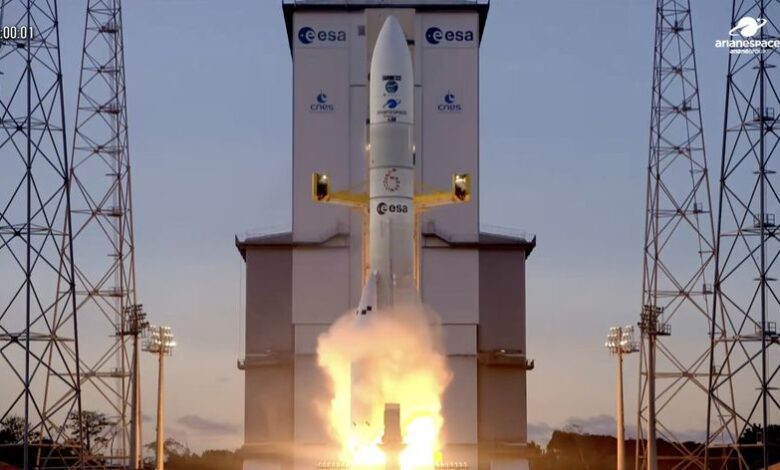
On the night of December 17, space professionals and enthusiasts alike will be watching the launch pad in Kourou, French Guiana. From here, the European heavy-lift rocket Ariane 6 will embark on its fifth mission, placing two new Galileo system satellites into orbit. This event is not only another step forward in the development of Europe’s navigation infrastructure, but also a significant milestone for the continent’s entire space industry.
The launch is scheduled for 12:01 PM US Eastern Time (05:01 GMT, 02:01 local time in Kourou). The event will be streamed live, with coverage beginning half an hour before the planned launch time. For Ariane 6, this mission will serve as further proof of its reliability and readiness for complex tasks on the international launch market.
New Horizons for Galileo
The two satellites on this mission will add to the operational Galileo constellation, which already includes 26 satellites. Galileo is Europe’s answer to the American GPS, offering high-precision navigation services for both civilian and governmental use. After separating from the rocket—about 3 hours and 20 minutes after liftoff—the satellites will deploy their solar panels and begin system checks.
Over the next three days, experts will monitor the condition of the satellites before a four-month drift and positioning phase places them in their target orbits. Only then will the satellites become fully operational, delivering even greater accuracy and reliability to Europe’s navigation network.
Continuity and Independence
Until recently, most Galileo satellites were launched into orbit by the Ariane 5 rocket, which completed its service in 2023, as well as by Russian Soyuz boosters. However, after the events of 2022 and the end of cooperation with Russia, Europe was forced to seek alternatives. Temporary launches using American Falcon 9 rockets provided a stopgap, but now, with Ariane 6 entering regular service, Europe has regained its independence in space launches.
The new rocket has already proven itself: four successful launches over the past year have strengthened confidence in the project. The fifth launch, carrying Galileo satellites, marks another step toward ensuring that European space missions no longer depend on external partners.
Technology and Prospects
Galileo operates at an altitude of over 23,000 kilometers above Earth. Each satellite weighs about 730 kilograms and is equipped with state-of-the-art communication and navigation systems. Thanks to ongoing upgrades and expansion, Europe can compete with the world’s leading navigation systems, offering users precise and reliable services.
Plans for further development of Galileo are already being discussed at the level of the European Space Agency (ESA) and the European Commission. In the coming years, new satellites are scheduled for launch, along with the introduction of additional features that will make the system even more valuable for business, transportation, and security.
If you didn’t know, Ariane 6 is the newest European launch vehicle, developed by ArianeGroup with support from the European Space Agency. It replaces Ariane 5 and is designed to place both commercial and government satellites into orbit. Galileo is a global navigation system created by the European Union to ensure independence from American and Russian counterparts. The launch operations and satellite management are handled by Arianespace, a company based in France.