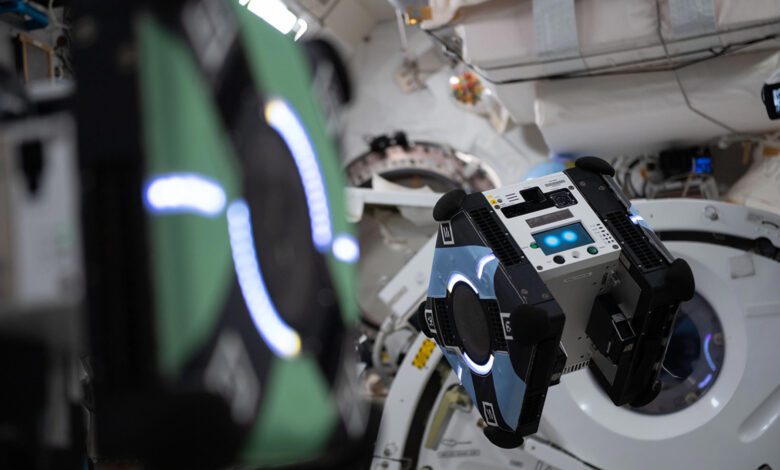
For the first time in the history of the International Space Station (ISS), an autonomous robot has managed to navigate the station’s complex interior using artificial intelligence. Researchers from Stanford University have implemented an innovative control system for NASA’s Astrobee—a small cube-shaped robot that can now independently chart routes and avoid obstacles in microgravity. This milestone could mark the beginning of fully autonomous space missions with minimal human involvement.
Navigation in zero gravity is no easy task, even for experienced astronauts. For robots, it becomes a real challenge: limited computing resources, the complex configuration of modules, and the constant presence of equipment make movement planning extremely difficult. Until now, autonomous systems have faced significant limitations, hindering their widespread use in orbit.
However, the new development from the Stanford team is a game changer. Using machine learning techniques, scientists have trained Astrobee to quickly and safely plot routes even in the most crowded sections of the station. This was made possible by a unique approach: the system analyzes thousands of previously calculated trajectories and uses them as a reference point for new plans, which significantly reduces computation time and increases navigation reliability.
A Technological Breakthrough
The core of the innovation is the so-called “warm start” principle. Instead of calculating the route from scratch each time, the artificial intelligence begins with a proven path, which is then optimized for current conditions. This approach is similar to planning a driving route based on the real experiences of other drivers, rather than drawing a straight line on a map.
The test results are impressive: routes generated with AI are computed 50–60% faster compared to traditional algorithms. At the same time, safety remains paramount—the system conducts thorough checks before each launch, and in case of a collision risk, it has virtual barriers and an option for immediate stop.
The experiment lasted four hours: specialists at the NASA Mission Control Center in Houston remotely operated Astrobee, sending it along 18 different trajectories. Each route was completed twice—once using artificial intelligence and once without it. This approach allowed for an objective assessment of the new technology’s effectiveness.
Testing on Earth and in space
Before sending the system into orbit, engineers conducted thorough tests on Earth. At the NASA Ames Research Center laboratory in Silicon Valley, a special granite table with an air cushion was used to simulate microgravity conditions. Here, Astrobee practiced maneuvers, gliding over the surface as if on air, allowing engineers to identify and resolve potential issues before the experiment began on the ISS.
Aboard the station itself, crew involvement was kept to a minimum: astronauts only prepared the equipment, after which control was fully transferred to specialists on Earth. NASA refers to this approach as “crew-minimal” — minimal crew involvement, which is especially important for future missions where human time and resources are at a premium.
During the testing, additional safety measures were implemented: virtual obstacles, the ability to perform emergency stops, and constant trajectory monitoring. These precautions helped to eliminate even the slightest risk to the equipment and the robot itself.
The future of autonomous missions
The experiment’s success opens up new possibilities for the use of artificial intelligence in space. In the future, similar systems will be able to handle routine tasks: equipment inspections, logistics, and conducting scientific experiments. This will free up astronauts for more complex and critical work, and on long-range missions—to the Moon, Mars, and beyond—robots will be able to operate with little to no intervention from Earth.
According to project leader Somrita Banerjee, autonomy with guaranteed safety is becoming not just desirable but essential for the future of space exploration. The farther robots travel from Earth, the more crucial their ability to make independent decisions and respond quickly to changing situations becomes.
The integration of artificial intelligence into the control of robots on the ISS is not only a technological leap but also a vital step toward establishing new standards of safety and efficiency in space programs. NASA and Stanford experts are already exploring ways to expand the use of such systems to other facilities and future missions.
In case you didn’t know, Astrobee is a series of autonomous robots developed by NASA for use on the International Space Station. They are designed to perform various tasks, from inspecting equipment to transporting small cargo. The project is being carried out in collaboration with leading U.S. universities, including Stanford University. Astrobee is equipped with cameras, sensors, and manipulators, allowing it to effectively interact with its environment and perform complex maneuvers in zero gravity.