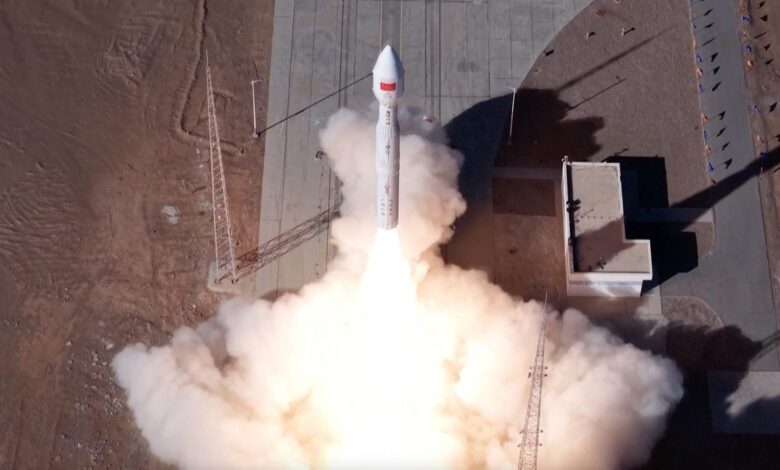
In December 2025, an incident in Earth’s orbit once again underscored the fragility of space. One of the recently launched Chinese satellites, deployed by the Kinetica 1 rocket, came dangerously close to a Starlink device owned by SpaceX. The distance between the objects was just 200 meters—a near miss by space standards, teetering on the brink of disaster.
SpaceX voiced serious concerns about the lack of coordination among satellite operators. A company representative noted that such situations are becoming more frequent and the risks continue to grow. This time, a collision was avoided, but the issue of orbital safety has come under renewed scrutiny.
Growing threat
The Kinetica 1 rocket, operated by the Chinese company CAS Space, was launched from a cosmodrome in the Gobi Desert and placed nine satellites into orbit. Among them were six multifunctional Chinese satellites, an Earth observation satellite for the UAE, a scientific satellite for Egypt, and an educational one for Nepal. It was not specified which of these came close to Starlink.
CAS Space stated that it uses ground-based tracking systems in planning launches to avoid crossing paths with other objects. Nevertheless, the company has pledged to conduct an additional review to clarify the details of the incident.
Overcrowded orbit
Over the past five years, the number of active satellites in orbit has almost quadrupled. In 2020, there were fewer than 3,400, but by the end of 2025 that number had reached nearly 13,000. The majority of new satellites belong to SpaceX: this year alone, the company launched over 3,000 new Starlink satellites, bringing the total to more than 9,000.
Starlink satellites are equipped with an autonomous maneuvering system that allows them to avoid potential collisions. In the first six months of 2025, Starlink satellites carried out around 145,000 collision-avoidance maneuvers—averaging four maneuvers per satellite each month. However, not all satellites operated by other companies have such capabilities, increasing the risk of unforeseen incidents.
The coordination problem
The main danger lies in the lack of data sharing between different operators. If satellite trajectories are not coordinated, even the most advanced systems may not prevent a sudden close approach. A SpaceX spokesperson emphasized that it was precisely this lack of coordination that led to a recent incident.
If two satellites—or even a satellite and a fragment of space debris—collide, the resulting debris cloud could trigger a chain reaction of new collisions. This scenario, known as the Kessler Syndrome, threatens to render some parts of orbit unusable for future operations.
The future of space traffic
Each year, the number of launches increases and orbit grows more crowded. Experts are calling for the creation of international standards and mandatory sharing of satellite trajectory data. Without this, even the most advanced technologies cannot guarantee safety.
In the coming years, the situation may only get worse: thousands of new satellites are set to be launched, including those for internet, observation, and scientific research. Regulation of space traffic is becoming not just relevant, but absolutely critical for the entire industry.
In case you didn’t know, SpaceX is an American company founded by Elon Musk in 2002. The company develops and launches rockets and is building the global satellite network Starlink to provide internet access worldwide. Today, SpaceX is the largest operator of satellites in low Earth orbit and is actively implementing innovative solutions to improve spaceflight safety.