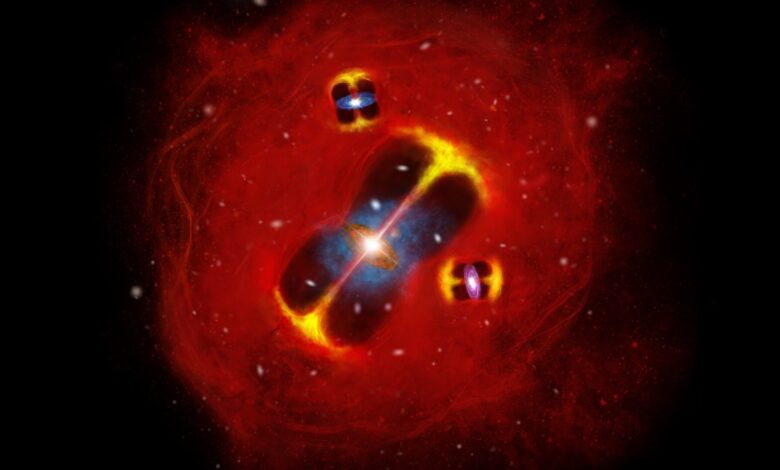
The scientific community is buzzing with debate after an international team of astronomers detected something truly unexpected in the depths of space. The focus is on cluster SPT2349-56—a gathering of more than 30 galaxies packed into a volume that, by cosmic standards, is remarkably tight: just half a million light-years across. But it’s not just the density that’s astounding. The temperature of the gas surrounding this cluster is five times higher than even the boldest theories predicted. And all of this—just 1.4 billion years after the Big Bang.
The discovery was made using the ALMA radio telescope array in Chile, immediately calling into question established ideas about how quickly such colossal structures can form. Until now, it was believed that heating the intergalactic medium to such extreme temperatures would take billions of years. SPT2349-56, it seems, decided not to wait and has broken all the rules.
Hotter than Expected
Inside the cluster, true cosmic heat rages: the temperature of the gas—what astronomers call the intracluster medium—exceeds that seen even in mature galaxy clusters of today’s Universe. Usually, such temperatures arise from gravitational compression and collisions as galaxies settle into stable structures over time. But here, everything is different—SPT2349-56 is still much too young to have gone through that process.
Researchers suggest that this intense heating is linked to the activity of three supermassive black holes recently discovered in the region. These cosmic giants apparently unleashed enormous blasts of energy as far back as the early universe, effectively ‘inflating’ the surrounding gas to unimaginable temperatures. This scenario contradicts the standard models of galactic cluster evolution.
Secrets of the Cosmic Microwave Background
To measure the temperature of the gas, scientists used the Sunyaev–Zel’dovich effect—a phenomenon where hot gas inside a cluster alters the properties of the cosmic microwave background (CMB) left after the Big Bang. As CMB photons pass through the cluster, they collide with fast-moving electrons and receive an extra boost of energy. The higher the ambient temperature, the more pronounced this effect becomes.
The results were astonishing: SPT2349-56 is not only hotter than expected, but it surpasses even many modern galaxy clusters in this regard. This discovery compels scientists to reconsider fundamental assumptions about how and when such structures first emerged in the Universe.
Protoclusters and Their Distinctions
Interestingly, astronomers have previously discovered galaxy clusters that existed even earlier, such as z660D and A2744z7p9OD, which appeared 770 and 650 million years after the Big Bang, respectively. However, these objects are called protoclusters: they had not yet become gravitationally bound systems, and their gas had not heated up to high temperatures.
SPT2349-56 stands out: it has already formed a stable structure and developed an “atmosphere” with characteristics comparable to mature clusters. This suggests that the formation and evolution of galactic clusters can occur much faster and more intensely than previously thought.
Star factory
Another striking feature of SPT2349-56 is its explosive rate of star formation. The galaxies in the cluster are still small, but stars are being born inside them so rapidly that the Milky Way seems like a tranquil haven by comparison: here, five thousand times more new stars appear each year than in our own galaxy.
Scientists are puzzled: how can such intense star formation, black hole activity, and a superheated environment coexist in such a compact and young system? There is no answer yet, but one thing is clear—SPT2349-56 presents a real challenge for modern astrophysics.
RUSSPAIN reminds readers that the ALMA Observatory (Atacama Large Millimeter/submillimeter Array) is the largest radio telescope in the world, located over 5,000 meters above sea level in Chile’s Atacama Desert. The complex consists of 66 antennas, allowing scientists to study the most distant and ancient objects in the universe. ALMA is regularly the source of sensational discoveries that reshape our understanding of space and its history.