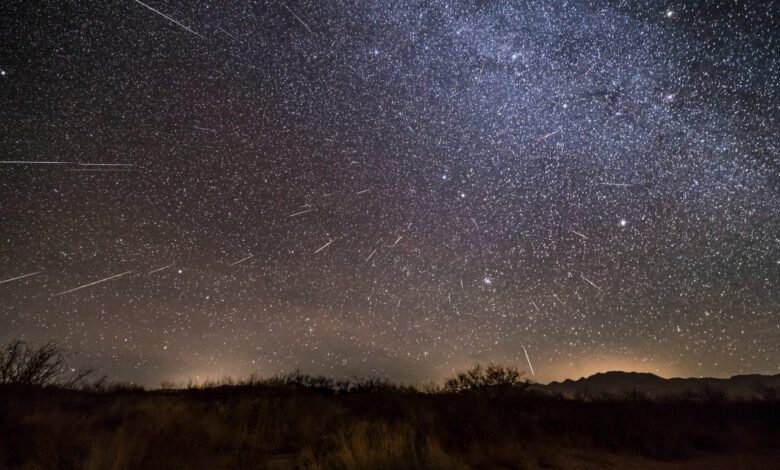
On the night of December 13 to 14, Spain will witness a spectacular celestial show as the Geminids meteor shower reaches its peak. Astronomy enthusiasts and anyone captivated by the beauty of the night sky will be able to see up to 150 meteors per hour, weather and lighting conditions permitting. This event is considered one of the most impressive annual meteor showers, as the Geminids are known for their brightness and high frequency of meteors.
The Geminids appear when Earth passes through a trail of dust and debris left by the unusual asteroid 3200 Phaethon. Unlike most other meteor showers, which are associated with comets, this one is born from an asteroid, giving it a special uniqueness. The particles that enter the atmosphere burn up, leaving bright trails—sometimes even brighter than Venus.
Where and when to watch
The best time to watch is after 10 PM, when the shower’s radiant, located near the star Castor in the constellation Gemini, rises higher above the horizon. At this time, the number of visible meteors will start to increase, and by 2 AM, when the sky is at its darkest, up to 60 meteors per hour can be expected even in suburban areas. In rural regions, free from city lights, the chances of witnessing the peak number of falling stars are much higher.
The first meteors can be seen as soon as darkness falls, but there will be few of them—they skim low over the horizon, leaving long, slowly fading trails. Such meteors are often called “earthgrazers” because they appear to glide along the atmosphere without penetrating deeply. After midnight, the shower intensifies, and by its peak—closer to dawn—the sky seems to light up with fiery streaks.
Tips for Observers
To get the most out of your stargazing, choose a spot away from city lights and give your eyes about half an hour to adjust to the darkness. Use a red flashlight to preserve your night vision, and don’t forget to dress warmly—December nights can be quite chilly. A comfortable chair or sleeping bag will help you spend a few hours under the open sky in comfort.
To find the radiant, use a mobile astronomy app: locate the star Castor in the constellation Gemini, then look about 30–40 degrees above it. For reference, the width of a clenched fist at arm’s length is about 10 degrees. In this area, the meteors will leave the longest and brightest trails.
Photography and Equipment
If you’re hoping to photograph the meteor shower, it’s best to prepare your equipment in advance. Wide-angle lenses and cameras with long exposure capabilities are ideal. Don’t forget a tripod and spare batteries—shooting the night sky requires time and patience. For inspiration, check out curated collections of the best meteor shower photos and tips from experienced astrophotographers.
If you decide to share your photos with a wider audience, be sure to include the location and your impressions. Such images always attract the interest of astronomy enthusiasts and those who simply appreciate the beauty of nature.
Shower Highlights
The Geminids stand out not only for the number of meteors, but also for their brightness. Even particles the size of a grain of sand can flare up in the sky, and larger fragments sometimes turn into real ‘fireballs’ that light up the sky for several seconds. This year, observers are in luck: the Moon will be only a quarter full, so its light won’t interfere with watching even the faintest meteors.
The shower is named after the constellation Gemini, from which all meteors appear to radiate. In December, this constellation is clearly visible in the east just after sunset, and by midnight it rises high above the horizon, providing excellent viewing conditions.
In case you didn’t know, asteroid 3200 Phaethon, which created the Geminid meteor shower, was discovered in 1983 and remains under close observation by astronomers. Its unusual orbit and characteristics make it unique among the small bodies of the Solar System. Every December, Earth crosses its path, resulting in one of the year’s brightest meteor showers. RUSSPAIN.COM reminds you: don’t miss the chance to witness this cosmic show — the next one won’t happen for another year.