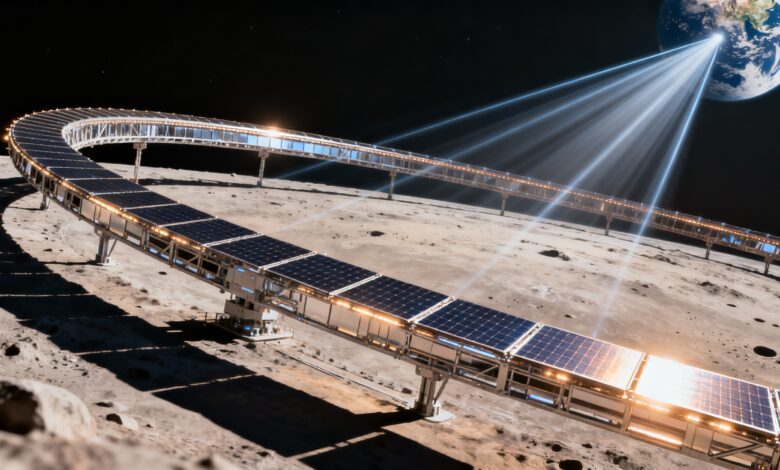
Japan is once again bringing up for discussion an idea that until recently seemed like science fiction: using the Moon as a constant and clean energy source for the entire planet. According to Talent24h, the Luna Ring project involves building a ring of solar panels along the lunar equator, capable of providing Earth with uninterrupted electricity.
Project essence
The plan is based on the Moon’s unique conditions. There is no atmosphere, clouds, or weather phenomena to hinder solar generation as they do on Earth. The ring of panels will stretch for 11,000 kilometers along the satellite’s equator, where sunlight is available almost continuously. This will make it possible to generate energy without the usual interruptions inherent to solar power plants.
According to the project’s calculations, Luna Ring could generate up to 13,000 terawatts—an amount that significantly exceeds current global demand. The key task is not only to collect this energy, but also to safely deliver it to Earth.
Energy transmission
The transmission system is based on converting solar energy into powerful streams of microwaves or laser beams. These beams will be directed from the Moon to special receiving stations—so-called rectennas—located on Earth’s surface. Here, the energy will be converted back into electricity and fed into the general grid.
This approach makes it possible to overcome the main drawback of terrestrial solar power stations—their dependence on time of day and weather conditions. According to engineers, the Moon becomes a giant orbital power plant operating without interruption.
Technical and economic challenges
The idea for the Luna Ring emerged amid the search for new energy sources following the Fukushima accident in 2011. Japan is actively seeking alternatives to nuclear and carbon-based generation, focusing on safety and environmental friendliness. However, implementing such a large-scale project faces a number of significant challenges.
Firstly, construction costs are estimated to be extremely high. Although the necessary technologies already exist, their use on the Moon requires fundamentally new solutions. It is assumed that a significant portion of materials will be produced directly on the lunar surface—from lunar sand and other local resources, with assembly handled by robots controlled from Earth.
Key technical challenges include minimizing energy loss over vast distances, ensuring precise beam targeting, protecting equipment from space debris, and reducing project costs. In addition, efficient assembly and installation of panels must be established under conditions of low gravity and the absence of atmosphere.
Additional opportunities
The project authors are also considering other uses for lunar energy. In particular, Luna Ring could become a source of hydrogen—an alternative fuel—which would further reduce dependence on fossil resources and accelerate the transition to a more sustainable energy sector.
Despite its ambition and scale, the Luna Ring project remains at the conceptual stage. However, its discussion highlights a growing interest in finding new solutions to global energy challenges and demonstrates how far engineering thought can go in the pursuit of a sustainable future.