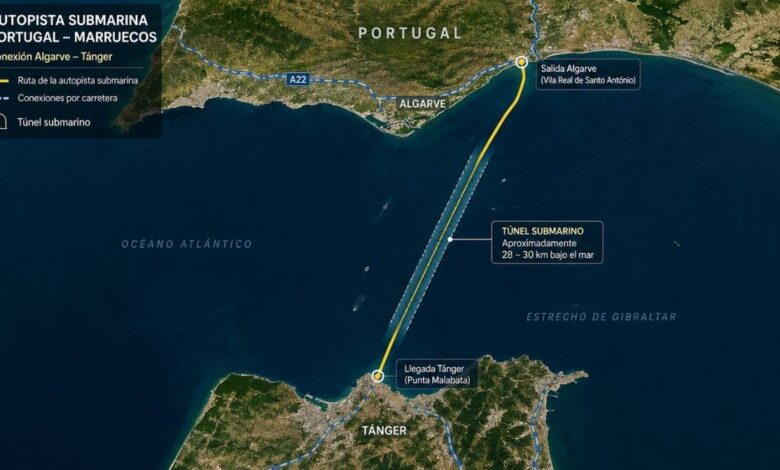
A major infrastructure project is starting in Europe: Morocco and Portugal are preparing to connect their shores with an underwater tunnel across the Atlantic. This initiative aims not only to shorten distances but also to create a new transport corridor between the two countries, which could reshape the region’s travel map.
The project is based on a dual-gallery motorway designed for traffic in both directions. Modern access roads will lead to the tunnel: on the Moroccan side, north of Tangier, and on the Portuguese side, connecting to the Algarve road network and the A22 motorway. According to Talent24h, the initial budget exceeds 800 million euros, but the final cost will depend on geological conditions, seismic risks, and the chosen financing scheme.
Structure and stages
The project is conceived as modular and will be implemented in stages to minimize disruption to regional traffic. The first stage includes environmental and geotechnical studies, as well as the development of a preliminary design. Construction of access roads and assembly areas will follow. Afterwards, the main underwater works and tunnel installation will begin. The final stage involves installing all systems, testing, and commissioning.
From a technical standpoint, the tunnel will consist of two separate galleries for each direction of traffic and an additional emergency corridor. For safety, modern ventilation systems, control stations with positive pressure, shelters, and sensors are provided. The project employs both prefabricated immersed elements and tunneling using specialized tunnel boring machines capable of operating under high pressure and in challenging marine conditions.
Safety and ecology
Safety and minimizing environmental impact are at the core of the project. To achieve this, multi-level monitoring systems, automatic sensors, hermetically sealed compartments, and well-designed evacuation protocols are planned. All infrastructure will be managed using digital models, allowing rapid response to any emergency and optimizing maintenance.
Particular attention is paid to the marine ecosystem: detailed studies are planned to assess the impact of construction on fauna, marine currents, and ecosystems. The goal is to minimize potential damage and ensure the region’s sustainable development.
Financial and organizational aspects
Although the initial budget exceeds 800 million euros, the final amount will be determined as technical specifications are clarified and the financing model is chosen. Key factors include the complexity of the seabed, potential seismic risks, and the need to integrate with existing transport networks. Tunnel management is expected to use automated payment systems, intelligent traffic control, and round-the-clock real-time monitoring.
Parallel projects
Simultaneously, work continues on another strategic initiative—the construction of a tunnel between Spain and Morocco across the Strait of Gibraltar. As Talent24h notes, in March 2025, the Spanish Minister of Transport visited Morocco to discuss details of this project. The planned tunnel, about 42 kilometers long with 28 kilometers underwater, will connect Punta Paloma in Spain and Punta Malabata in Morocco. The design includes three galleries: two for rail transport and one for technical and safety needs. According to estimates, construction could be completed between 2030 and 2040.