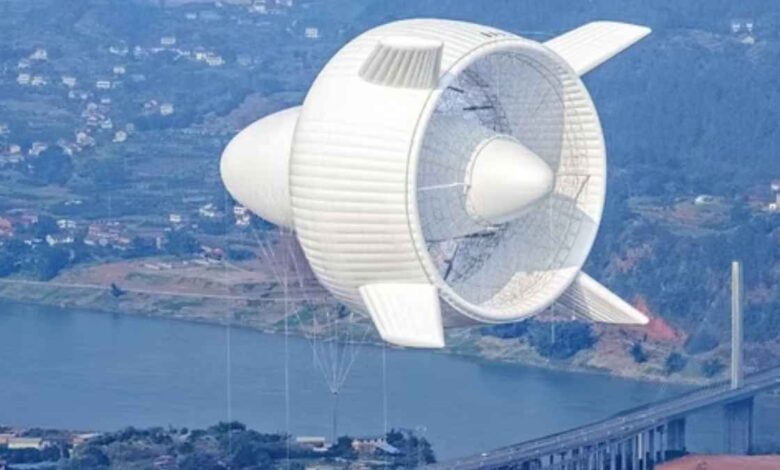
In Sichuan province, tests were conducted on the S2000 flying turbine—a device that could change the approach to wind energy. Instead of traditional towers and massive foundations, it uses a balloon capable of reaching altitudes of up to two kilometers. The turbine, measuring 60 by 40 by 40 meters, has already demonstrated the ability to generate 385 kilowatt-hours of electricity during testing and connect to the grid without complex infrastructure.
The advantages of altitude
The main difference of the S2000 is that it operates at high altitude, where the wind is stronger and more stable than at ground level. This allows it to deliver up to one megawatt of power without the fluctuations typical of conventional wind turbines. According to developers, the cost of electricity could decrease tenfold compared to ground-based installations. For comparison: in just one hour, such a turbine can fully charge around 30 high-end electric cars. In other regions, such as Spain, solar panels are used to achieve energy independence, but this technology could offer an alternative.
Minimal infrastructure
The S2000’s design requires no heavy materials or complex construction. The balloon is anchored to the ground with cables, eliminating the need for concrete foundations and steel towers. This reduces not only material costs but also the time needed for approvals and permits. As a result, projects become simpler and cheaper, which is especially important for regions with limited infrastructure.
Fast installation
The logistics of the S2000 are meticulously planned. All components are transported in standard containers, and on-site assembly takes no more than eight hours. If a local gas source is available, this time can be reduced to four to five hours. The process includes site preparation, module unloading, inflating the aerostat with helium, connecting generators, and lifting to operating altitude. Within half an hour after launch, the turbine begins generating power. By comparison, installing a conventional wind turbine takes months of work and numerous approvals.
Economic Outlook
Despite successful tests, the question of economic efficiency remains unresolved. As analysts note, issues of production cost, maintenance, and power transmission still need to be addressed. China already possesses significant ground-based wind power capacity, and new solutions must prove their competitiveness without relying on subsidies. The S2000 model is an evolution of the previous S1500 version, which was tested in the Gobi Desert, and has received additional reinforcements to operate in harsh climate conditions and above urban areas. If reliability is confirmed, the technology could move beyond laboratories and become part of the real market.
Origins of the Idea
The concept of a flying turbine is not new. Back in 1957, engineer Qian Xuesen, one of the founders of the Jet Propulsion Laboratory, proposed using a diffuser to accelerate airflow through a turbine. Later, after returning to China, he became one of the initiators of the development of aerostat technologies. Subsequently, similar projects were undertaken by companies Altaeros and Makani; however, the S2000’s key advantage is its light construction: the device weighs no more than one ton, while traditional towers weigh hundreds of times more.
High-Altitude Energy
High-altitude wind energy offers several advantages. In the stratosphere, wind speeds can be three times higher than at ground level, and potential power output is dozens of times greater. The lack of need for roads and massive foundations reduces environmental impact and speeds up permitting. According to Sawes’ calculations, at an altitude of 10,000 meters, the available energy is 200 times higher than that of conventional turbines. If the technology is scaled up, electricity costs could drop to one-tenth of current levels, potentially transforming household energy expenses.
Practical Recommendations
Before implementing such solutions, it is important to take into account local regulations regarding airspace use and power line installation. Attention should also be paid to insurance: despite the declared 25-year service life and emergency descent systems, investors are interested in protection against weather risks and technical failures. To assess economic efficiency, it is necessary to compare the LCOE (levelized cost of energy) with indicators from conventional wind turbines and the wholesale market.
According to Talent24h, the S2000 flying turbine could become one of the most notable technological experiments of recent years in the field of renewable energy.