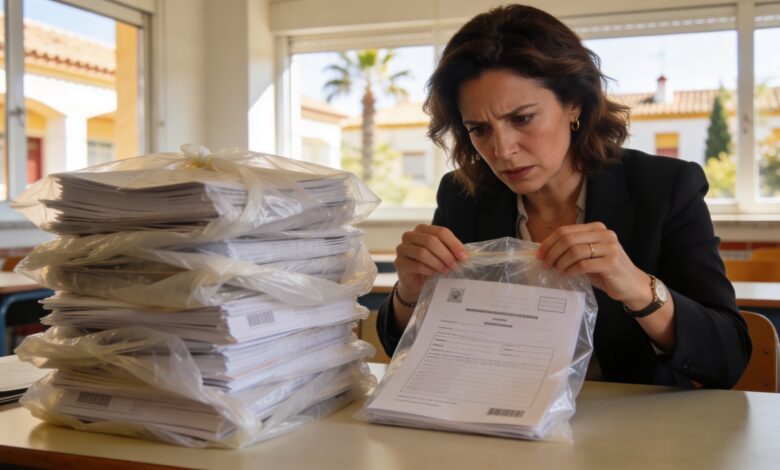
A scandal has erupted in Andalusia over the administration of diagnostic exams for 4th grade students: 280,000 tests, which were supposed to be protected against early opening, arrived at schools without proper sealing. Instead of the promised transparent, heat-sealed bags, the materials were merely fastened with plastic ties or placed in easily opened bags, making it possible to access them without any trace. This has sparked a wave of discontent among principals and inspectors, who fear a repeat of previous exam leaks.
Breach of contract terms
According to the public contract, awarded to General Machines Technology SL for €155,848, the packaging was required to guarantee full integrity and allow contents to be visible, with no way to open it without detection. However, as noted by several school principals, in practice the boxes with tests arrived either without any bags at all or with packaging that could be opened and resealed without leaving any trace. In some cases, boxes were already open upon receipt. Representatives of education unions emphasize that such violations cast doubt on the objectivity of the test results and may lead to widespread leaks of exam tasks.
Response from authorities and the contractor
Regional authorities stated that they are inspecting the contract’s execution and do not rule out sanctions against the contractor for non-compliance with the conditions. The Andalusian Ministry of Education emphasizes that school principals are responsible for the safekeeping of the materials, but acknowledges that the packaging method chosen proved insufficiently reliable. According to representatives of the principals’ association, the problem arose due to technical limitations of the contractor’s equipment, which was unable to pack large batches of tests in accordance with the requirements. Authorities promise to take this experience into account for the next procurement.
Risks to objectivity and trust
Exams in mathematics, language, and foreign language were supposed to remain sealed until the start of the test itself to prevent prior preparation of students and ensure the integrity of the results. However, due to weak packaging, principals had the opportunity to review the tasks in advance, which could affect the level of preparation and school results. Inspectors believe such failures undermine trust in the assessment system and could lead to distorted statistics for the region.
Context and comparison with other regions
Diagnostic tests are conducted in all 17 autonomous communities of Spain, but each develops its own assignments and sets its own standards of difficulty. This makes it impossible to directly compare results between regions, as experts note. Last year, similar problems with the organization of exams already led to leaks and disputes over the fairness of assessments. Other regions also face conflicts surrounding educational initiatives: for example, in Catalonia, schools opposed the presence of police officers on school premises, a topic covered in detail in the article about the mass refusal of high schools to participate in the pilot project with the ‘mossos’.
Details and consequences
This year, the tests for second-year secondary school students in Andalusia are being conducted electronically, which eliminates the problem of physically delivering and storing materials. However, for primary grades, the issue of exam security remains acute. After testing is complete, schools receive a comparative analysis of the results, taking into account the economic and social index, as well as the regional average. According to several principals, despite the shortcomings of the procedure, participation in these diagnostics allows schools with low results to receive additional resources, although not everyone believes the tests are useful for the actual educational process.