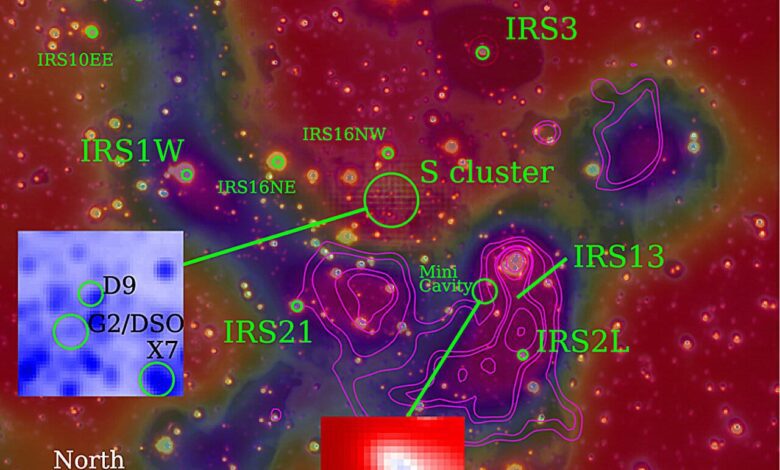
In the very heart of the Milky Way, where gravity reaches extreme levels and the density of stars defies imagination, scientists have recorded a remarkable phenomenon. Four mysterious objects, located in close proximity to the supermassive black hole Sagittarius A* (Sagittarius A*), have, contrary to expectations, continued to exist and display remarkable resistance to the destructive tidal forces. This discovery was made possible thanks to an analysis of data obtained using the advanced ERIS instrument, mounted on the Very Large Telescope (VLT) in Chile. An international team of researchers, led by Florian Peißker of Universität zu Köln, conducted a detailed study of the orbits and physical properties of these objects, known as G2/DSO, D9, X7, and X3.
Previously, it was believed that such close proximity to a black hole would inevitably doom any stars or gas clouds. However, new observations have shown that these bodies have not only survived but continue to move along stable paths, maintaining their integrity. This challenges previous assumptions about how stars behave under the extreme conditions in the Galactic center.
Hidden stars
Scientists have paid special attention to the object G2/DSO. Its infrared emission and dusty envelope long led astronomers to think it was an ordinary gas cloud doomed to be torn apart when passing through perihelion—the point of closest approach to the black hole. However, spectroscopic data contradicted these expectations: G2/DSO retained its compact shape and did not lose brightness, indicating the presence of a young star inside, surrounded by a dense cocoon of gas and dust. According to researchers, it is this shell that protects the star from destructive tidal forces.
Another object, D9, turned out to be the first confirmed binary system near the center of the Milky Way. Analysis of spectral lines helped refine the orbital parameters and identify the characteristic periodic shifts typical of binary stars. Both components of the system remain stable for now, but models predict they may merge in the future, resulting in a more massive star.
Unexpected stability
Object X7, previously thought to be a fragment of a gas stream, turned out to be another star shrouded in a dense dust envelope. Its elongated shape and steady orbital motion indicate that it is not being destroyed, despite its proximity to the black hole. This discovery has prompted scientists to reconsider the nature of such objects in the central region of the Galaxy.
The fourth subject of the study, X3, is located slightly farther from the center and displays signs of activity characteristic of stars with accretion disks and strong stellar winds. Over the observation period, its velocity increased by about 100 kilometers per second, which may indicate interaction with the surrounding material or gravitational influence from a more massive object.
Life in Extreme Conditions
All four objects continue to move along their predicted orbits with minimal deviations—calculations are accurate to within one or two percent. This means that even in close proximity to a supermassive black hole, stars and star-like bodies can exist for tens of millions of years without being destroyed. This finding surprised many experts and opened up new perspectives for studying star formation processes under extreme conditions.
Astronomers note that further observations using the James Webb Space Telescope and the METIS instrument, which will be installed on the Extremely Large Telescope (ELT), will provide deeper insight into the nature of these mysterious objects. It’s possible that in the coming years, the first episodes of new star formation in the very center of the Milky Way will be recorded.
The Future of Research
The discovery of stable star systems near a supermassive black hole is changing our understanding of the dynamics and evolution of galactic centers. Scientists now face the task of uncovering exactly how such objects form and survive, as well as the role they play in the overall development of the Galaxy. New observational tools and methods promise to provide answers to these questions—and may even lead to more unexpected discoveries.
If you weren’t aware, Sagittarius A* is a supermassive black hole located at the center of the Milky Way, about 26,000 light years from Earth. Its mass is roughly four million times that of the Sun. Universität zu Köln is one of Germany’s leading research centers and actively participates in international astronomical investigations. The Very Large Telescope (VLT) in Chile is regarded as one of the most powerful ground-based astronomical complexes in the world and is regularly used to observe objects at the core of our Galaxy.