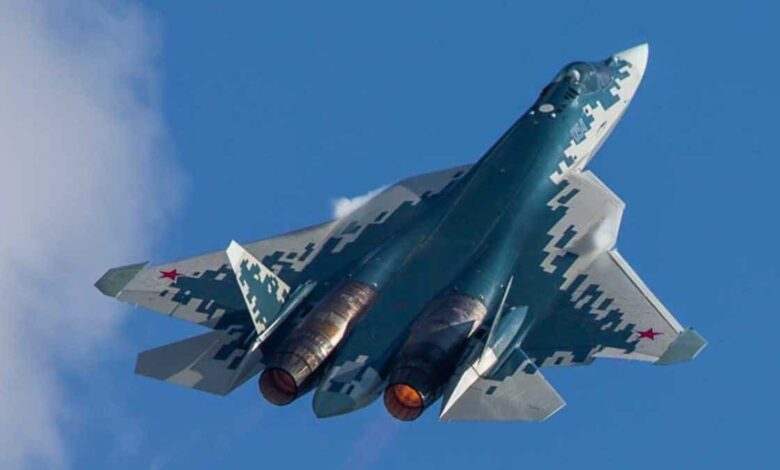
A debate has erupted in American military circles over which modern fifth-generation fighter would prevail in a real air combat scenario. This time, the spotlight is on Russia’s Su-57 and China’s J-35A—both jets are considered technological breakthroughs in their respective countries, but their designs and priorities differ significantly.
The Su-57, developed in Russia, is positioned as a versatile platform capable of handling a wide range of missions. Engineers prioritized exceptional maneuverability, high speed, and an array of advanced sensors. In contrast, the Chinese J-35A was designed with a focus on stealth and integration into a unified digital combat management network. This approach allows the pilot to operate with the principle that whoever spots the enemy first gains the advantage in an attack.
However, despite the J-35A’s lower radar cross-section, experts note that in a one-on-one duel, the Russian jet could prove to be a more formidable opponent.
Technical Differences
The main distinction between the two aircraft lies in their operational philosophy. The Su-57 is equipped with powerful electronic warfare systems, enabling it to effectively counter modern detection and targeting technologies. Additionally, the Russian fighter carries long-range R-37M missiles, capable of striking targets up to 300 kilometers away.
The J-35A, on the other hand, is focused on stealth and close integration within networked groups. Its pilot can receive information from other aircraft and ground stations, increasing the chances of detecting the enemy first and launching a strike from a distance. However, in close-range combat, these advantages can be neutralized.
Maneuverability and armament
In close air combat, the Su-57 gains an extra edge thanks to its unique maneuverability. The Russian jet can execute complex aerobatic maneuvers, making it difficult for the adversary to target and forcing the enemy into a disadvantageous fight. This tactic could prove decisive if the engagement turns into a direct confrontation.
The Chinese J-35A, while equipped with advanced control systems and modern armaments, falls short of the Su-57 when it comes to maneuverability. Its main strengths lie in stealth and the ability to coordinate actions with other participants in the air battle. However, in a one-on-one duel, these qualities are not always decisive.
Engagement scenarios
Analysts emphasize that the outcome of a dogfight between the Su-57 and the J-35A largely depends on the circumstances. If the engagement occurs at long range, the Chinese jet may try to capitalize on its advantages in detection and stealth. But if it comes down to close combat, the Russian fighter can seize the initiative through its maneuverability and powerful arsenal.
In modern warfare, aerial combat rarely comes down to classic dogfights. However, comparing the capabilities of the Su-57 and J-35A offers insight into how different design approaches impact the effectiveness of these fighter jets.
The Future of Aerial Combat
Experts note that technological advances are making air battles increasingly complex and unpredictable. The integration of artificial intelligence, new electronic warfare systems, and improved missile technology are changing the rules of engagement. In such an environment, even small differences in an aircraft’s performance can prove decisive.
Nevertheless, the Russian Su-57 remains one of the most talked-about additions to the world of military aviation. Its capabilities attract interest not just from specialists, but from military analysts around the globe.
For reference, the Su-57 (NATO reporting name: Felon) is a Russian fifth-generation multirole fighter developed by Sukhoi. It first took to the skies in 2010 and has undergone multiple upgrades since. The J-35A is China’s newest carrier-based fighter, created by AVIC for the needs of the Chinese Navy. Both jets are seen as symbols of technological progress in their respective countries and are the subject of active discussion within the expert community.