This year, Madrid risks making history in Formula 1—not only by bringing back the Grand Prix, but also by creating the most talked-about corner of the championship. While some debate team prospects and engines, Spain’s capital is building a track where a single section could change the course of the race and the drivers’ fate. The spotlight is on the turn already nicknamed ‘Monumental’—and with good reason: its specs command respect even from the most seasoned motorsport fans.
Unlike the typical straights and standard curves, engineers here decided to go all in. Curve number 12, stretching 550 meters with a 24% slope, will truly test nerves and machines alike. Cars will blaze through this stretch at over 300 km/h, while the audience—45,000 people—will witness side-by-side battles as several cars dive into the turn at once. Thrills are guaranteed, but safety remains an open question.
Organizers admit: the aim is spectacle and uniqueness. In an era when every Formula 1 stage tries to stand out, Madrid is taking a bold gamble. And if anyone thinks this is just another attempt to recreate Senna’s ‘S’ or Eau Rouge, they’re mistaken—this is grander and, perhaps, more perilous. It’s no surprise tickets for this section are selling faster than fresh churros at Easter.
Chasing Records
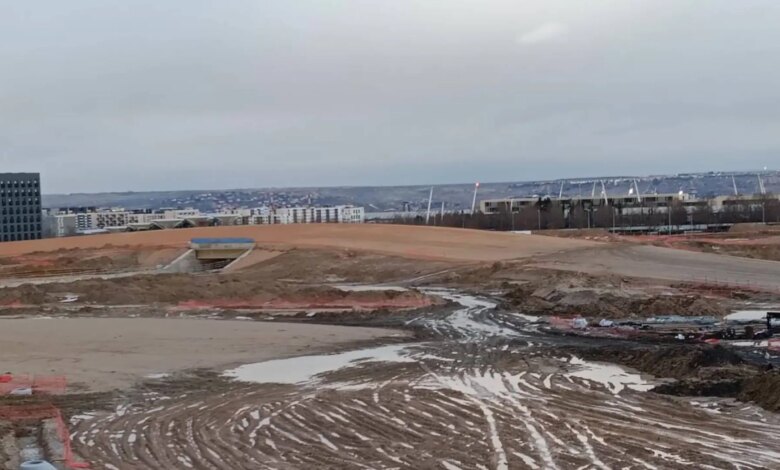
The circuit is not yet complete, but work is progressing at such a pace that even racing cars would be envious. The ‘Monumental’ corner was among the first to be constructed due to its complex geometry and strict safety requirements. Today, this section is considered the most advanced in terms of readiness, and you can already appreciate the project’s ambitious scale. The entire MadRing track (as the new city racetrack is now called) stretches for 5.4 kilometers and features 22 turns, but it is the 12th turn that promises to become the hallmark of the event.
Drivers will complete 57 laps around this circuit, with an average lap time of about 1 minute and 32 seconds. For comparison, in Barcelona, where races are held on a traditional racetrack, such extreme zones simply don’t exist. In Madrid, however, the organizers decided not to stick to conventional standards and have created something that is already sparking debate among experts and fans. Speaking of technical details and risks for the teams — recently experts voiced concerns about whether some manufacturers are truly prepared for the season’s new challenges, and this only fuels the anticipation for the upcoming events.
The second half of the championship promises to be especially intense: that’s when Madrid will host the sixteenth round, and all eyes will be on the Monumental. After years of fighting to bring Formula 1 back to the capital, the organizers haven’t just built a circuit—they’ve created an arena for real duels. There’s no room for caution here: the wide corners allow several cars to run side by side, dramatically increasing the risk of collisions. It’s a spectacle for fans, but a headache for the drivers.
Spanish flair
The Monumental drew inspiration not only from the legendary turns of other circuits, but also from Madrid’s own atmosphere. The semi-circular shape evokes a bullring, while the banking recalls the best moments of NASCAR and Zandvoort. Unlike those tracks, where such features are an exception, here it’s the focal point of the entire circuit. Engineers insist: this mix of length, banking, and width is unmatched in the championship. If drivers can tackle this section without losses, their names are certain to enter history.
Let’s not forget the fans: massive new grandstands will be built so everyone can feel part of the action. Forty-five thousand seats aren’t just a number—they’re a challenge for organizers and a guarantee of a full house. Fans are already debating who will dare to attack at full throttle first, and who will play it safe. One thing is clear: no one will be left indifferent.
While some debate the merits of such experiments, others are already planning their trip to Madrid. After all, where else can you see modern gladiators challenging not only their rivals but also the laws of physics at speeds of 300 km/h? The ‘Monumental’ promises to become not just another turn, but a symbol of a new era of Formula 1 in Spain.
MadRing isn’t just another stop on the Formula 1 calendar. It’s an ambitious project designed to return Madrid to the center stage of global motorsport. Since its opening, which featured Carlos Sainz, work has continued nonstop. Every stage of construction has been accompanied by discussions and debates, but the result is already impressive—even for the most skeptical fans. In the coming years, this circuit may well become the place where new legends are born and records are rewritten.