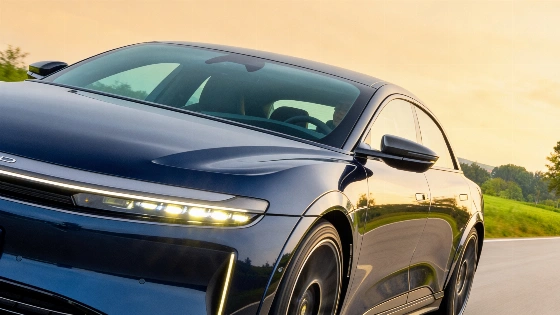
Lucid Air Sapphire: the American electric sedan changing the game. The Lucid Air Sapphire is a rare sight on European roads, but its specs command respect even among Porsche and Tesla fans. Why is this electric car seen as a new benchmark for the premium segment, and what's behind its record-breaking numbers? RUSSPAIN investigates.
The Lucid Air Sapphire is unlike any other electric car found on European roads. With 1,251 hp, three electric motors, and a top speed of 330 km/h, it makes even models like the Porsche Taycan Turbo GT less noticeable next to this American sedan. But behind the impressive numbers lies not just marketing, but genuine engineering that is redefining what electric vehicles are capable of.
Origin and Concept
The Lucid Air Sapphire is the result of the ambitions of former Tesla engineers, including ex-CEO Peter Rawlinson, who set out to create not just a fast electric car, but a premium product that combines Tesla innovation, Mercedes quality, and Porsche dynamics. The interior features a curved display reminiscent of the Taycan, a center console inspired by the EQS, and finishes worthy of McLaren. At the same time, the interface is truly intuitive and logical, which still remains an issue for many German brands.
Technology and Records
The main strength of the Lucid Air Sapphire is not just its power, but its technological solutions. The 118 kWh battery with an operating voltage of over 900 volts provides not only a range of up to 1,000 km in less extreme versions, but also fast charging. Three electric motors (two at the rear, one at the front) deliver 1,940 Nm of torque, allowing it to accelerate to 100 km/h in a time comparable to the Taycan Turbo GT—but on standard road tires. Moreover, the Sapphire maintains maximum traction even past 250 km/h, and the limiter only kicks in at 330 km/h—before the motors begin to lose efficiency.
In real-world conditions, this means that on the autobahn, the driver more often has to brake than accelerate: the dynamics are so aggressive that acceleration phases are shorter than braking phases. The ceramic brakes handle the load well, though the 2,412 kg weight is still noticeable at high speeds.
Dynamics and handling
Despite its substantial weight, the Lucid Air Sapphire surprises with its precision and neutrality in corners. The suspension is adaptive but lacks active stabilizers like some competitors, so at the limits of grip, physical constraints are apparent. Nonetheless, torque distribution between the two rear motors enables active torque vectoring, providing an advantage when exiting corners: power is delivered to the wheels as efficiently as possible, and the car doesn't unsettle the driver with sudden loss of traction, as often happens with the Taycan.
It's impressive that the Lucid Air Sapphire remains relevant five years after its market debut—a near era for an electric vehicle. The only areas where its age is noticeable are charging speed and battery thermal management: newer competitor models already offer slightly faster solutions. However, in terms of overall balance, the Sapphire still ranks among the most technologically advanced sedans.
Market context
The arrival of the Lucid Air Sapphire on the European market is a notable event. Unlike mass-market Chinese models that focus on affordability and fast charging—like the updated BYD Atto 3 with a range of 630 km and a 9-minute charge (more on BYD's approach), Lucid is focusing on premium and engineering solutions that currently remain unrivaled in their overall combination of qualities.
Conclusion
The Lucid Air Sapphire is an example of how an American electric car can not only catch up with, but also surpass European leaders in several key areas. Its performance, build quality, and technological foundation make it one of the most interesting and rare vehicles on the market, while for those who value speed and innovation, it is a true challenge to conventional standards.