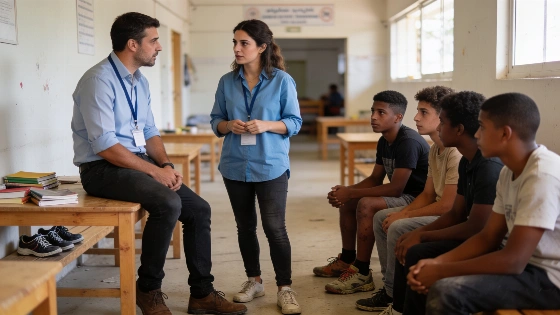
Fourteen autonomous communities have agreed to send €25 million to Ceuta for unaccompanied migrant minors. Several PP-led regions supported the move but called the funding insufficient. The measure follows a surge in arrivals after July 30.
Fourteen Spanish autonomous communities have endorsed the government's plan to allocate €25 million to Ceuta for the care of unaccompanied migrant children and teenagers, following the mass entry of minors on July 30. The decision, reached during a meeting with the Ministry of Youth and Children, saw broad support from regions governed by the Partido Popular (PP), with the notable exceptions of Castilla y León, Extremadura, and Aragón. These three regions, where child welfare policies are managed by Vox, formally rejected the measure and did not attend the session, continuing their absence from previous preparatory meetings.
Despite backing the financial transfer, several PP-led territories described the sum as inadequate for the scale of the challenge. Madrid's regional councillor for Family, Ana Dávila-Ponce de León, argued that €25 million would only cover two months of care for the more than 1,500 minors currently in Ceuta. She also insisted that all minors should be returned to their families in Morocco, opposing any relocation to mainland Spain or distribution among other regions.
The Sectoral Conference, the main forum for coordination between the central government and the autonomous communities on child welfare, focused on two agenda items: the €25 million transfer and the situation of minors in Ceuta. PP regions objected to discussing the latter, claiming it was added irregularly, and the Ministry ultimately withdrew the topic. Representatives from Andalucía (PP), Madrid, and the Canary Islands (co-governed by CC and PP) attended in person, while Galicia, Cantabria, La Rioja, Murcia, the Valencian Community, Balearic Islands, Ceuta, and Melilla joined remotely. Socialist-led Navarra and Catalonia were present, as were the Basque Country (PNV), Asturias (PSOE), and Castilla-La Mancha (PSOE) via video link.
The meeting highlighted four distinct positions: Vox's boycott, PP's conditional participation, and full cooperation from the remaining five regions. Ceuta, Melilla, and the Canary Islands formed a separate bloc, seeking to share responsibility for the minors with other territories. The government maintains that returning children to their families is the priority, but acknowledges that repatriation is often delayed by the need to locate families or secure safe conditions in Morocco. The Ministry proposes immediate redistribution of minors across Spain, allowing identification and interviews to proceed in various regions, with subsequent decisions on repatriation or continued care.
Uncertainty remains over the exact number of minors in Ceuta. While NGOs have cited figures as high as 4,000 and the Minister of Economy, Carlos Cuerpo, mentioned over 2,900, the Ministry of Youth and Children now estimates 1,500 after removing duplicate records. However, some children remain unregistered or unidentified. The Ministry has also suggested the urgent transfer of 500 girls to private NGO facilities on the mainland, but emphasizes that Ceuta, as the legal guardian, must authorize any such move.
Recent months have seen Ceuta under intense pressure due to the influx of unaccompanied minors, with local authorities and NGOs struggling to provide adequate shelter and support. The debate over funding and responsibility reflects broader tensions between regional and national governments on migration policy. As noted in a related report, the government is also preparing to relocate hundreds of vulnerable migrant girls from Ceuta to mainland Spain, underscoring the urgency and complexity of the situation.
Spain's approach to unaccompanied migrant minors is shaped by both national law and international obligations. Autonomous communities are responsible for the care and integration of these children, but regions like Ceuta and Melilla, due to their geographic location and border status, face disproportionate challenges. The current funding package aims to address immediate needs, but ongoing disagreements over distribution, repatriation, and long-term solutions suggest that the issue will remain a point of contention among Spain's regions and political parties.