How Burela Became Home to One of the Largest Cape Verdean Communities in Spain. Burela in Galicia is an example of how migration can transform a town. Since the late 1970s, it has become home to one of the most prominent Cape Verdean communities, shaping the economy, culture, and daily life.
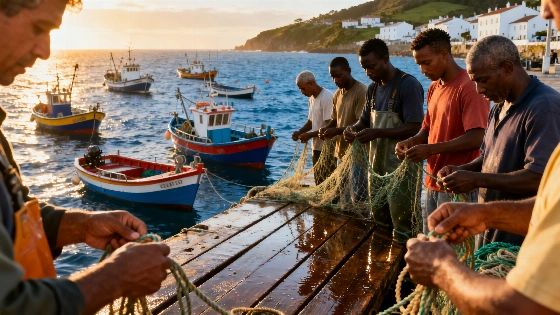
Burela, a small town on the coast of the Lugo province, has long since stopped viewing migration as something new or temporary. As early as the late 1970s, families from Cape Verde began to arrive here, and over decades, their presence has become an integral part of local life. Initially, people were drawn by work in fishing, and later — by opportunities related to the development of the aluminum industry in the region.
Today, the Cape Verdean community is one of the most prominent in Burela. According to the municipality, the city is home to representatives of 52 nationalities, and the total population exceeds 10,000 people. As El Progreso notes, Cape Verdeans constitute one of the largest and most integrated groups.
Roots of migration
The first migrants from Cape Verde arrived in Burela in 1978. This period has been thoroughly studied in academic works, with special attention given to the role of women in the process of adaptation and integration. For many men, fishing became the main source of employment, while construction and subsequent work at the Alcoa aluminum plant opened new prospects for families who decided to stay in Galicia.
When construction of the plant was completed, some workers from Cape Verde did not leave, but moved into the fishing sector. This allowed the community to take root and gradually become part of the city’s economic and social fabric.
Modern Burela
Over recent decades, migrants from Cape Verde have ceased to be simply newcomers. Their children and grandchildren were born in Galicia, attend local schools, participate in city life, and maintain ties with their historical homeland. According to El Progreso, by 2025 Burela was home to more than 52 nationalities, and the population exceeded 10,000 people. City authorities emphasize that the contribution of the Cape Verdean community is noticeable not only in the economy, but also in the city’s cultural life and in shaping an atmosphere of openness.
In 2020, as Cadena SER reported, natives of Cape Verde were the largest group among foreign residents of the city. In recent years this trend has only intensified, and today Burela is seen as one of the most multicultural cities in the region.
A maritime past and new connections
Historically, Burela has always been linked to the sea. As early as the 16th century, the local port was known as a hub for whaling and coastal fishing. This tradition created conditions for newcomers from Cape Verde to find here not only work, but also their place in society.
Fishing has become not just a profession, but a foundation for building a stable community. Over time, Cape Verdeans have not only integrated, but have also contributed to the city’s development while preserving the culture and traditions of their ancestral homeland.
A city of change
Today, Burela is not just a port on the Lugo coast. It is an example of how migration can transform a city, making it more open and diverse. For more than forty years, one of the strongest and most prominent Cape Verdean communities in Spain has taken root here. This experience demonstrates how shared history and labor become the foundation for new forms of coexistence and mutual respect.