In Pont-de-Barret, a rural French village, locals sidestepped the collapse of public transport by sharing a single Citroën ZX. Their grassroots system now keeps the community moving and challenges assumptions about rural mobility.
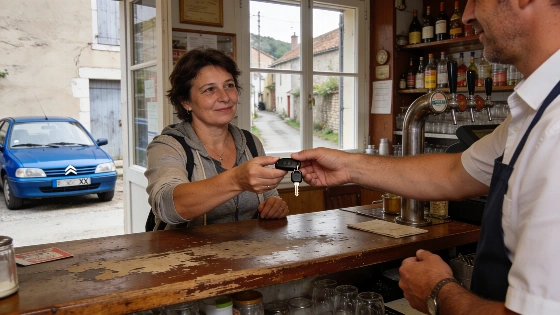
In Pont-de-Barret, the keys to getting around aren’t managed by a government office or a tech company—they’re kept behind the bar counter, ready from early morning until late at night. For many in this small French village, a well-worn blue Citroën ZX has become the only reliable way to get where they need to go, filling a gap that official transport never managed to close.
With just one bus a day and no train service, the village’s 660 residents found themselves cut off. Five neighbors, tired of waiting for outside help, decided to do something about it. They started a car-sharing system that’s as simple as it gets. The car, a hand-me-down from a grandfather, is unlocked with a code and started with a key anyone can borrow from the bar. Each trip is logged by hand in a shared notebook, with drivers recording kilometers and fuel costs.
Official regional data confirms that Pont-de-Barret, like many rural communes in Drôme, faces limited intercity transport routes and only sporadic demand-responsive services in neighboring areas.
“It’s automatic, has a code to start, and even a radio-cassette,” says Xavier Charles, one of the founders. The ZX, once a fancy Paris car, now makes two or three trips a week for its users. For some, it means they no longer need a second car. For others, like Camille Gandioli, it’s the only way to get her children to school. “Normally I cycle, but with kids, that’s impossible,” she told Reporterre. The rules are straightforward: pay 25 cents per kilometer to cover fuel and upkeep, and write down your journey. Since late 2021, the car has covered more than 30,000 kilometers.
For Christian Deloraine, an 81-year-old retired luthier, the shared Citroën is more than just handy—it’s essential. “I have modest means and this car has saved my life,” he says. The setup isn’t charity. Each user pays their share, and the car is open to anyone who needs it, whether it’s for a rainy day, a trip to town, or when their own car is out of action.
The idea has spread beyond Pont-de-Barret. In nearby Crest, locals have organized a similar system with eight cars and over forty users. For many, car sharing isn’t just about saving money or cutting emissions—it’s about having the freedom to get around, something rural life often makes difficult. The ZX still burns fuel, but sharing means fewer cars overall, and the environmental cost of ownership is spread out among more people.
According to open transport data in France, vehicle sharing and car sharing are officially recognized as part of the national mobility system, and hybrid solutions like demand-responsive transport and subsidized carpooling are already being implemented in rural regions.
Solutions like this are rare in places where rural transport is usually an afterthought. As reported earlier, the struggle to get around isn’t unique to France. Across Europe, as public transport fades outside big cities, people are left to improvise.
Pont-de-Barret’s approach stands out because it’s entirely local. There’s no corporate platform, no government funding, and no digital system—just neighbors, a Telegram chat, and a willingness to share. The bar, open from 7 a.m. to 10 p.m., is the hub for the whole operation. The idea has already inspired nearby villages to try their own versions, each adapting the model to fit their needs.
According to Google/SpainAuto, Pont-de-Barret shows that when official solutions fall short, communities can still find their own way. The shared Citroën ZX isn’t about nostalgia or resisting change—it’s a practical fix, built on trust and necessity. In a region where rural needs are often overlooked, this village has quietly found a way to keep moving.