The actress joined Madrid’s Puerta del Sol camp as evictions and a housing shortage pushed the protest beyond youth politics. Her message cast access to homes as a national issue.
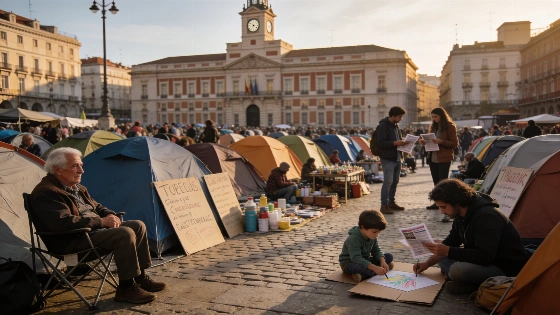
On 27 September, Aitana Sánchez-Gijón joined the housing camp at Madrid’s Puerta del Sol and distributed food among young demonstrators. She used the visit to make a wider claim about Spain’s housing crisis: access to housing affects people of every age.
The scene also carried a personal connection. Her eldest son, Teo Lucadamo, was among those taking part. Sánchez-Gijón presented her presence as civic responsibility rather than family support alone, and said the camp revived the spirit and enthusiasm associated with the 15-M movement.
By 10–11 October, the Puerta del Sol camp had grown to around 1,800 tents across approximately 12,000 square metres, with protesters marking out 62 squares and 56 streets.
The dispute unfolded alongside political pressure around a contested Madrid campsite. The protest began on 26 September after the eviction of Mari-Carmen, a housing activist. It gained further momentum after the failure of government housing decrees and the announcement of early elections for 29 November.
RTVE reported that demonstrators refused to step back after the election announcement. They argued that the political timetable did not resolve the underlying housing emergency.
What began as a response to one eviction became a sustained public occupation. Organised spaces and marked-out streets turned the site into temporary civic infrastructure in central Madrid. The camp then became a focus of tension between regional and central authorities.
The High Court of Madrid refused to authorise a forced eviction sought by the regional government. The Government Delegation in Madrid likewise argued that removing the camp could create more security problems than it solved, while the State Legal Service said the advantages of such a measure were not sufficiently clear.
The government of Madrid’s regional president, Isabel Díaz Ayuso, demanded that the action end and called it an illegal occupation of public space. Her rhetoric grew more confrontational, including a link between the situation and terrorism. The judicial refusal to approve an immediate eviction allowed the camp to remain and kept the dispute in the national spotlight.
The supply shortage gives the protest’s demands a hard numerical edge. Calculations based on data from Spain’s National Statistics Institute and the Ministry of Housing indicate that roughly 1.22 million new households were created between 2021 and 2025. About 466,000 homes were built during that period, leaving a shortfall of approximately 756,000 housing units.
The gap is particularly visible in Madrid. It also affects Barcelona. Valencia, Alicante and Murcia face the same pressure.
Those figures explain why Sánchez-Gijón framed housing as a cross-generational issue rather than a concern limited to younger protesters. Evictions affect families at different stages of life. Rising rents add another strain, while the lack of new homes has turned the conflict between Madrid’s regional authorities and Spain’s central government into an institutional dispute.
By the third week of the protest, police were monitoring radical groups around the camp. The action itself continued to be described as predominantly peaceful. The court’s refusal to authorise an immediate dispersal gave demonstrators more time to press both the national government and the regional administration for a response.
Sánchez-Gijón’s intervention connected the camp’s immediate demands with the wider housing crisis. Her message focused on the experience of eviction and the gap between household growth and construction. Rent pressure and decisions by governments at different levels were also part of that argument.
The High Court of Madrid had refused to authorise an immediate forced eviction.