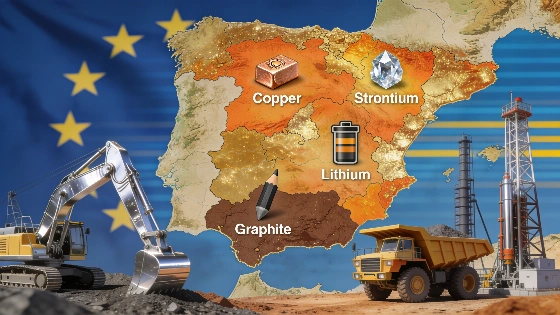
Andalusia now has its first map of critical minerals, pinpointing 365 sites for 14 EU-listed substances. The project could reshape industrial supply chains and boost regional mining prospects.
Andalusia has taken a decisive step in the European race for strategic raw materials with the release of its first critical minerals map. Developed by three geologists from the Instituto Geológico y Minero de España (IGME-CSIC), the new tool identifies 365 locations across the region where 14 substances, classified as critical by the European Union, have been found or extracted. This mapping comes as the EU intensifies efforts to secure resources vital for energy transition and reduce reliance on external suppliers.
The map offers a simplified geological and topographical overview of Andalusia, highlighting areas with evidence of critical minerals. According to the research team, each marked site is linked to historical data on past mining activity, providing a solid foundation for future exploration and investment. The project is designed to help both public authorities and private companies quickly assess where further studies or extraction might be viable, potentially accelerating new mining initiatives.
However, the landscape for critical minerals is shifting rapidly. When the map was created, the EU's 2020 list included 30 substances; by 2026, that number has risen to 34. The inclusion of copper, for example, has significantly increased Andalusia's strategic importance, as the region is one of Europe's and the world's leading copper producers. This change directly impacts sectors such as electrification and decarbonisation, where copper is essential.
Researchers stress the need for regular updates to the map to keep pace with evolving industrial demands and EU criteria. The methodology allows for relatively straightforward revisions, but the process depends on institutional priorities and available resources. The IGME is currently engaged in the National Mining Exploration Plan, which may affect the timing of future updates. Still, experts argue that maintaining an up-to-date map is crucial for informed decision-making in both government and industry.
Beyond its technical value, the map has immediate economic implications. Mining companies can use the data to identify promising areas for expansion, while regional authorities gain a clearer picture of Andalusia's potential in the European context. The region already stands out for its unique strontium deposits—the only ones in production in the EU—and is the world's top producer of this mineral. Andalusia also holds significant reserves of fluorite and tungsten, further strengthening its position as a key supplier of critical materials.
From a European policy perspective, the drive to map and exploit domestic resources is part of a broader strategy to reduce dependence on imports. The EU regularly reviews its list of critical raw materials, adjusting priorities based on market demand and supply risks. For Andalusia, staying aligned with these updates is essential to remain competitive and relevant in the sector.
According to the European Commission, the demand for critical minerals is expected to grow sharply in the coming years, driven by the expansion of renewable energy, electric vehicles, and digital infrastructure. Spain, and Andalusia in particular, are well positioned to benefit from this trend, provided that exploration and extraction are managed sustainably and in line with long-term planning. The new map is seen as a powerful visual and practical tool to guide these efforts, offering a snapshot of the region's resources at a time when strategic autonomy is a top EU priority.