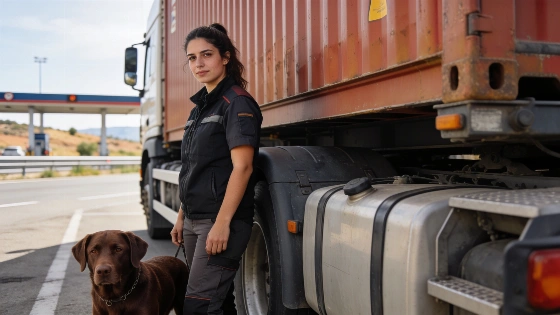
Andrea Fernández, a young truck driver from Pontevedra, navigates Spain’s highways with her dog Brugal, challenging outdated views about women in transport. Her story highlights the realities and motivations behind a demanding profession.
Andrea Fernández, 26, spends her days and nights on Spain’s highways, transporting containers across the country. Originally working in a vegetable warehouse in Pontevedra, she became intrigued by the world of trucking after meeting drivers who delivered goods before dawn. Despite initial concerns from those around her—mainly about the risks involved—Fernández was determined to earn her license and pursue a career that few women in her region have chosen.
Her work is anything but routine. Fernández rarely visits the same client twice in a row, and her schedule is dictated by the demands of each delivery. “There are no fixed hours,” she explains. “If I’m scheduled to load at 9 a.m., I have to calculate my own departure time from home.” Managing her own time is essential, especially when faced with unpredictable delays, such as waiting in long lines to load cargo or spending hours at a port for her container to be ready. On one occasion, she waited five hours before she could continue her route.
Fernández is never alone on the road—her chocolate labrador, Brugal, is a constant companion. While many imagine truck drivers passing the time with music, she says most prefer to stay connected with colleagues via phone calls, sharing jokes and stories to break up the monotony. “We even create our own soap operas,” she laughs, describing the camaraderie that helps drivers cope with the isolation of long journeys.
Challenging the stereotype that trucking is a man’s job, Fernández points out that opening a container is physically demanding for anyone, regardless of gender. She notes that women remain a minority in the sector—she has only seen two others in her area—but insists that being a woman can be an advantage. “It’s quite the opposite of what people think. Here, being a woman often means someone is willing to lend a hand,” she says. Her motivation comes from proving to herself—and to others—that she can succeed in a field where few expected her to thrive, a journey she documents on social media as @andrius__99.
Her experience echoes a broader trend of individuals breaking into traditionally male-dominated automotive spaces. For example, the passion for high-performance vehicles brings together people from different backgrounds, as seen when Real Madrid’s goalkeeper and a well-known YouTuber bonded over their shared love of racing at Jarama, detailed in this report on motorsport enthusiasts.
According to elespanol motor, Fernández’s story is a reminder that the transport sector is evolving, with more women entering roles once considered off-limits. While challenges remain, her determination and adaptability reflect a new generation of drivers redefining what it means to work on Spain’s roads. The Spanish transport industry continues to face a shortage of drivers, making stories like Fernández’s not only inspiring but also increasingly relevant as the sector seeks to attract new talent.