Spanish cities are struggling with extreme heat, but architect José Luis Esteban Penelas believes the solution lies in rethinking urban design. He advocates for more vegetation, better materials, and strategic building orientation to create cooler, healthier environments.
As temperatures in Spain’s largest cities continue to climb, architect and professor José Luis Esteban Penelas is challenging the status quo of urban planning. Instead of relying on temporary fixes like fans or umbrellas, Penelas argues that the real answer to extreme heat lies in transforming the very fabric of city life—starting with how streets, buildings, and public spaces are designed.
Penelas, who teaches architecture and building at Universidad Europea, recently explained on La Brújula (Onda Cero) that Spanish cities are ill-equipped to handle prolonged heatwaves. Asphalt streets, treeless plazas, and buildings that trap heat for hours have become the norm, making daily life increasingly uncomfortable and even dangerous. According to Spain’s Ministry of Health, 3,832 deaths were attributed to excessive heat between May and September 2025, while MoMo estimates reported 1,029 heat-related deaths in June 2026 alone.
Green Infrastructure as a Solution
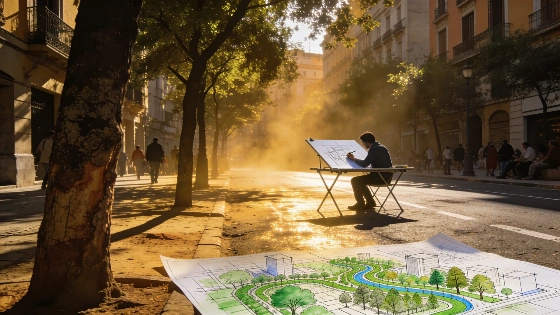
Penelas’s vision goes far beyond simply planting more trees. He proposes a comprehensive shift toward what he calls “humanized forests”—urban environments where vegetation is treated as essential infrastructure. This means integrating tree canopies, green facades, pergolas, shaded corridors, and moisture-retaining spaces that release coolness during the day. Such measures, he says, can help cities break the cycle of heat absorption and retention that currently defines their built environment.
The phenomenon of the urban heat island is well documented by AEMET, Spain’s meteorological agency. Asphalt and ceramic rooftops absorb and store solar radiation, while green spaces and vegetated roofs can significantly reduce this energy buildup. Penelas’s approach aligns with a growing recognition that cities must adapt not just for comfort, but for public health and resilience.
Materials and Building Orientation Matter
One of the key reasons city centers feel so stifling, Penelas notes, is the widespread use of heat-trapping materials like black asphalt and concrete. These surfaces store warmth throughout the day and release it at night, making it difficult for residents to cool down and rest. The difference in temperature between a city’s core and its outskirts can reach 6 or 7 degrees Celsius, he points out.
Building orientation is another overlooked factor. Well-designed structures can maintain cooler interiors, reduce reliance on air conditioning, and make public spaces more usable during the hottest months. Penelas emphasizes that smarter urban layouts can help mitigate the worst effects of heatwaves, especially in places where people gather—such as schools, bus stops, and plazas.
Reviving Traditional Solutions
Penelas also advocates for reviving time-tested methods to make cities more livable. He cites the example of historic water channels that once ran through streets before the construction of the Canal de Isabel II, as well as the use of granite and natural stone for paving—materials that reflect rather than absorb heat. These traditional approaches, he argues, can be adapted to modern needs and help reduce thermal stress in everyday urban life.
His proposals echo a broader European trend toward sustainable infrastructure. For instance, Switzerland’s ambitious underground tunnel network, as described in this report on freight transport innovation, demonstrates how reimagining city systems can yield significant environmental and social benefits.
Ultimately, Penelas’s call to action is clear: to protect public health and quality of life, Spanish cities must move beyond short-term fixes and invest in greener, smarter, and more resilient urban environments. As climate risks intensify, the way cities are built and maintained will play a decisive role in shaping the future of urban living.