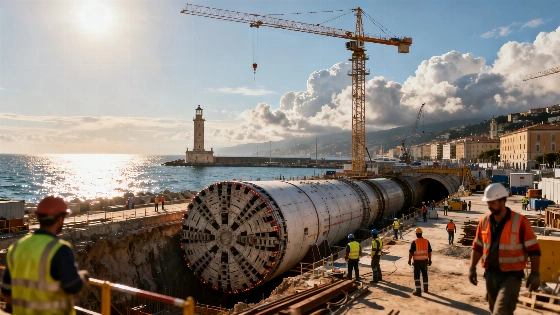
Beneath the Swiss Alps lies a 2,000-kilometer labyrinth of tunnels, reshaping how goods and people move across Europe. Switzerland’s ambitious underground infrastructure aims to protect its mountains by moving freight off highways and onto trains.
Every train journey through Switzerland is marked by a familiar moment: daylight vanishes, the carriage plunges into darkness, and the reflection of passengers flickers in the window. What feels routine is, in reality, a passage through one of the world’s most extensive underground networks—a hidden country beneath the Alps, engineered to change the way Europe moves.
Switzerland has spent more than a century carving tunnels through its mountains. According to ETH Zurich, the country’s subterranean web now includes over 1,400 tunnels and galleries, stretching more than 2,000 kilometers. This intricate system carries not only trains and vehicles, but also water, electricity, and vital technical services—an essential backbone for a nation defined by its rugged terrain.
Engineering the Alpine Base Tunnels
The centerpiece of this underground revolution is the New Rail Link through the Alps (NRLA or NEAT), a project that unites the Lötschberg, Gotthard, and Ceneri base tunnels. These tunnels form a flatter, faster rail corridor beneath the mountains. The Gotthard Base Tunnel, at 57 kilometers, became the world’s longest railway tunnel when it opened in 2016. Its scale is matched by its impact: travel times are cut, and freight trains can be longer and heavier, reducing the need for extra locomotives on steep gradients.
This engineering feat is not just about speed. By making rail transport more efficient, Switzerland is actively encouraging freight to shift from road to rail—a move designed to protect the fragile Alpine environment from the heavy toll of truck traffic.
Why Switzerland Is Moving Freight Underground
The driving force behind this strategy is environmental protection. Since 1994, the Swiss constitution has mandated that transalpine freight be transferred from road to rail. The law set a clear target: reduce heavy truck crossings from 1.4 million in 2000 to 650,000 per year.
To achieve this, Switzerland has combined major tunnel projects with road tolls for heavy vehicles and incentives for combined transport. According to the Federal Office of Transport, these measures have already brought annual truck crossings below one million, though the goal remains challenging. In 2025, 960,000 trucks still crossed the Swiss Alps, and rail’s share of Alpine freight slipped from 70.3% to 68.6%, affected by construction, disruptions on European corridors, and economic headwinds.
Managing the Environmental Impact
Building tunnels on this scale inevitably leaves a mark. The Gotthard Base Tunnel alone required 152 kilometers of tunnels, galleries, ventilation shafts, and safety passages, and the removal of 28.2 million tons of rock. Switzerland sought to minimize local damage: construction materials were moved by rail or boat whenever possible, machinery was fitted with particle filters, and wastewater was treated and cooled before entering rivers and streams. Dust and noise controls were enforced in nearby communities.
These efforts reflect a broader lesson for Europe: tunnels are neither simple nor cheap solutions, but with stable funding, strict standards, and a real commitment to shifting freight to rail, they can fundamentally reshape mobility across the continent.
Switzerland’s underground network stands as a model of how infrastructure, policy, and environmental priorities can align. As European transport faces growing pressure to decarbonize and protect natural landscapes, the Swiss approach offers both inspiration and a practical blueprint for the future.