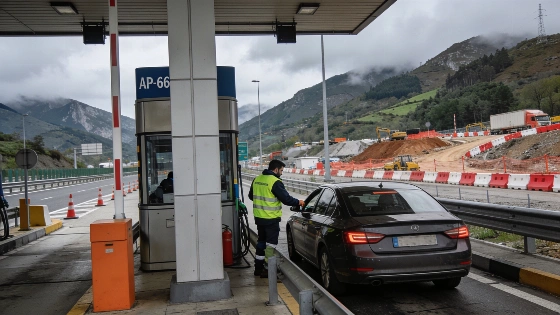
Asturias seeks a €1.1 million fine for full tolls on the AP-66 during major works. The Ministry of Transport rejects the sanction and joins the case. The conflict deepens as users and businesses demand relief.
The conflict between the Government of Asturias and Spain’s Ministry of Transport has intensified after Asturias initiated a €1.1 million sanction against Aucalsa, the concessionaire of the AP-66 (autopista del Huerna), for charging the full toll during extensive roadworks. The Ministry has formally opposed the sanction and entered the proceedings, arguing that the regional government’s action disregards national regulations on toll roads and the specific circumstances of the ongoing repairs.
The sanction, approved by the Asturian Council of Government, is based on claims that Aucalsa failed to properly inform users about disruptions and that maintaining the full €16.20 toll during works constitutes an abusive practice. The main works include repairs after a landslide in November 2024 and tunnel renovations, with Aucalsa and the Ministry each responsible for different sections. The Ministry insists that safety and urgent repairs justify temporary restrictions and that users have been kept informed through traffic panels, official communications, and the DGT website.
Transport officials also highlight that significant traffic delays have been rare and that toll discounts of up to 60%—funded by the Ministry—have saved users over €132 million. They cite Royal Decree 439/2023, which places responsibility for claims arising from these works on the Ministry and makes the repairs mandatory under EU law. The Ministry’s intervention is partly motivated by concerns it could be liable for part of the fine as the road’s owner.
Asturias, however, continues to press for a full toll suspension during the works, arguing that more than half the route fails to meet normal standards. The regional government has repeatedly called on the Ministry to take control of the concession and address longstanding complaints. The Ministry’s move to join the case has drawn mixed reactions within the Asturian executive, with some officials calling it routine and others expressing surprise at the timing and intent.
The dispute has triggered strong responses from political parties, transport associations, and civil groups. Opposition deputies accuse the central government of siding with the concessionaire over Asturian residents, while transport leaders describe the Ministry’s stance as a provocation. Social and business organizations have also joined the legal battle, with the Asturian Federation of Entrepreneurs (FADE) and major transport associations filing their own challenges before the Supreme Court.
Consumer groups have escalated the issue, with the Unión de Consumidores de Asturias filing a complaint with the public prosecutor alleging possible fraud by Aucalsa for charging full price during works. The Plataforma Ciudadana Peaje Huerna ¡No! has submitted further complaints to both regional and national prosecutors and the Transparency Council, seeking action on toll charges and alleged document concealment.
As the legal fight spreads across Asturias, Madrid, and Brussels, the European Commission’s ongoing case against Spain—sparked by a complaint from former Podemos deputy Daniel Ripa—continues to question the legality of the AP-66 concession extension to 2050. In parallel, the Asturian government and business sector have appealed to the Supreme Court after the Ministry refused to review the extension. This multi-front dispute has transformed a long-standing regional grievance into a complex judicial and administrative standoff.
For context, similar tensions between regional and central authorities over transport policy have surfaced in other parts of Spain, as seen when operational lapses and government responses in Ceuta drew public scrutiny and political backlash. For more on such disputes, see this analysis of government crisis management in Ceuta: how government handling of regional crises can fuel controversy.
The AP-66, a key route linking Asturias and León, remains one of Spain’s most expensive toll roads. The outcome of this dispute could set a precedent for how tolls are managed during major infrastructure works and how responsibilities are shared between regional and national authorities. The case also highlights the growing role of European oversight in Spanish transport concessions and the increasing willingness of local actors to pursue legal remedies at multiple levels.