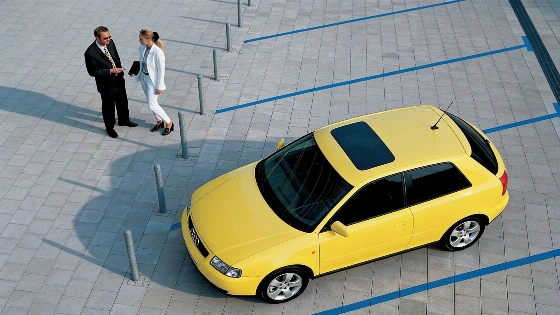
Audi’s 1996 launch of the A3 did more than add a new model. It carved out a premium niche in a segment ruled by the VW Golf, setting a new standard for compact cars and changing the industry’s direction.
In 1996, Audi did something no one expected. The company rolled out the A3. It wasn’t just another hatchback. Audi aimed straight at a market that brands like Volkswagen, Peugeot, Opel, and Renault had owned for years. This was the moment the compact premium car stopped being a slogan and became real.
The first A3 measured only 4.15 meters. That’s small, even for the 1990s. But Audi’s ambitions were big. Dirk van Braeckel, the lead designer, refused to shrink an old model. He wanted a car with its own look and feel. The A3 had to stand apart. It needed to justify a higher price and a more exclusive image than any regular rival. That was the goal.
The Audi A3 was first shown at the Frankfurt Motor Show in 1996 and reached the market that autumn, marking Audi's entry into the compact premium segment.
Under the skin, the A3 shared the PQ34 platform with the Volkswagen Golf IV, Seat León, New Beetle, and Audi TT. Audi did this on purpose. The platform was flexible. It let Audi build a car that felt unique but still used the group’s industrial muscle. The code name said it all: P for 'Passagier', Q for a transverse engine. The focus was on space and efficiency in a tight package.
From day one, Audi put the A3 above the best-equipped mainstream compacts but below the BMW Serie 3 Compact. The starting price? Just over three million pesetas, or about 18,000 euros back then. That sent a clear message. This car was for buyers who wanted more than the usual, but weren’t ready to jump into full luxury.
The first engines were simple. A 1.8-liter naturally aspirated unit with 125 CV. Audi didn’t wait long to add more. Quattro all-wheel drive versions with Haldex differentials soon joined the lineup. That gave the A3 a technical edge. The real shift came in 1999. Audi launched the S3 with 210 CV. Suddenly, the A3 wasn’t just refined. It was fast. It could compete with real performance cars.
According to Il Fatto Quotidiano, the Audi A3 has become one of the brand's most successful models, with more than 5.5 million units sold worldwide. The model also played a key role in pushing Audi toward a more technological and upscale positioning, being the first compact Audi to offer all-wheel drive.
Diesel fans got their turn too. The TDI versions started with 110 CV, then 130 CV. That pulled in more buyers. The 1.8 T with 180 CV and the S3’s later jump to 225 CV pushed the top end even higher. Audi also offered simpler models, like a 102 CV naturally aspirated engine. That was for people moving up from mainstream brands. The lineup kept growing.
This approach had risks. Making Audi more accessible could have watered down its premium image. But the gamble worked. The A3’s success forced other luxury brands to rethink their own lineups. Now, every major premium brand has a compact model. That wasn’t true before the A3.
The A3 family kept growing. Audi added new body styles. The cabriolet kept its fabric roof for years. The sedan gave a new spin to the original three-door idea. Production spread to Györ, Curitiba, and Foshan. Audi chased global demand. Sales eventually topped four million units. That’s a big number.
The A3’s impact fits with other car revolutions. The Fiat 600 Multipla changed family cars decades earlier, as reported earlier. The A3 found a gap in the market and turned it into a premium stronghold. It was a smart move.
The first A3 didn’t need to be the biggest or the fastest. It didn’t shout for attention. Its real win was spotting an open space and building a car that made rivals rethink everything. Three decades later, the A3’s mark is clear. It proved a compact car could be both desirable and practical. That changed the European car market for good.