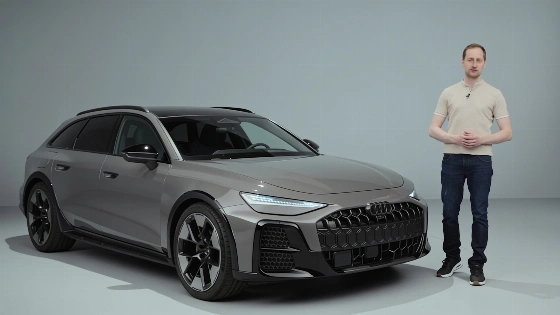
Audi introduces the 2026 A6 Allroad with a wider stance, adaptive air suspension, and both V6 TDI and plug-in hybrid options. The model aims to offer real versatility and premium technology without following the SUV crowd.
The 2026 Audi A6 Allroad arrives with a clear message: you don't need an SUV to get adventure-ready capability and premium comfort. Built on the A6 Avant platform, the latest Allroad stands out with a body widened by 111 millimeters, giving it a more assertive presence while maintaining the familiar estate silhouette. The signature Singleframe grille, bold air intakes, and protective lower cladding reinforce its rugged intent, but Audi avoids turning the car into a caricature of off-road excess.
Key to the Allroad's transformation is its adaptive air suspension, now standard and offering 55 millimeters of height adjustment. Even at its normal setting, the Allroad sits 34 millimeters higher than a standard A6 Avant with air suspension. For tougher terrain, offroad and offroad+ modes add another 15 millimeters, and a lift function can raise the car by 20 millimeters more at low speeds. On the flip side, dynamic mode drops the ride by 20 millimeters, and at speeds above 120 km/h, the car lowers further to improve efficiency. This dual character—capable off the beaten path, composed on the highway—sets the Allroad apart from typical SUVs.
Handling is sharpened by a more direct progressive steering setup and optional four-wheel steering, which can turn the rear wheels up to five degrees in the opposite direction. For a car measuring 5.016 meters in length, this makes a tangible difference in agility and maneuverability. Audi has also equipped the Allroad with off-road-specific digital displays, including tilt, height, steering angle, compass, and coordinates, all integrated into the MMI system.
Inside, the cabin closely mirrors the standard Audi A6, prioritizing quality materials, generous space, and a suite of digital screens. The MMI panoramic display dominates the dashboard, featuring an 11.9-inch Audi virtual cockpit and a 14.5-inch central touchscreen. An optional 10.9-inch display for the front passenger adds flexibility, allowing navigation input or media playback via Bluetooth headphones. While the abundance of touch surfaces streamlines the look, it does mean more reliance on menus for everyday controls.
Lighting technology is another highlight. Digital Matrix LED headlights can project warnings onto the road, while the rear OLED 2.0 taillights use 198 segments per side to communicate maneuvers to other drivers. Rear passengers benefit from a 2.93-meter wheelbase, optional panoramic roof, four-zone climate control, and an executive ambiance that leans more toward luxury than ruggedness.
Luggage space is generous, with the V6 TDI version offering 466 liters (expandable to 1,497 liters), while the e-hybrid's battery reduces capacity to 404/1,423 liters. This trade-off is typical for plug-in hybrids but worth noting for those who prioritize cargo room.
Under the hood, the Allroad offers two distinct powertrains. The 3.0 V6 TDI delivers 299 hp and 580 Nm of torque, featuring MHEV plus mild-hybrid tech and an electric compressor. This diesel variant accelerates from 0 to 100 km/h in 5.4 seconds, reaches 250 km/h, and claims fuel consumption between 5.8 and 6.4 l/100 km—making it a logical choice for long-distance travel and towing.
The new plug-in hybrid e-hybrid pairs a 2.0 TFSI petrol engine with an electric motor for a combined 367 hp and 500 Nm. Its 25.9 kWh battery enables up to 95 kilometers of electric range (WLTP), with AC charging at up to 11 kW taking about 2.5 hours. There is no DC fast charging, which limits flexibility for spontaneous long trips. The e-hybrid matches the diesel's top speed and posts a 0–100 km/h time of 5.5 seconds, but the battery and price add complexity to the Allroad's traditionally straightforward formula.
Pricing starts at €90,275 for the V6 TDI and €90,450 for the e-hybrid, positioning the Allroad firmly in the premium segment. Towing capacity is another differentiator: the diesel can pull up to 2,500 kg, while the e-hybrid is rated for 2,000 kg—an important factor for buyers who need real utility.
For those weighing the Allroad against the SUV mainstream, Audi's approach is clear: less show, more substance. The Allroad offers a lower center of gravity, true quattro all-wheel drive, and a family-friendly estate body, making it a compelling alternative for drivers who value precision over posturing. This philosophy echoes a broader trend in the market, as seen with other adventure-oriented models like the Nissan X-Trail, which recently introduced its own rugged trim and hybrid tech—details explored in this analysis of the updated X-Trail.
In summary, the 2026 Audi A6 Allroad remains a niche, premium, and distinctly German answer to the SUV question. It doesn't try to replace the SUV; instead, it demonstrates that for many, a well-engineered estate with real capability is all you need.
Additional context: The Allroad's adaptive air suspension and quattro system have long been benchmarks for combining comfort and off-road ability in the premium segment. Plug-in hybrid estates are still rare, especially with this level of towing capacity. Audi's decision to keep the V6 TDI alongside the e-hybrid reflects ongoing demand for diesel in long-range, high-utility vehicles, particularly in European markets where towing and efficiency remain priorities.