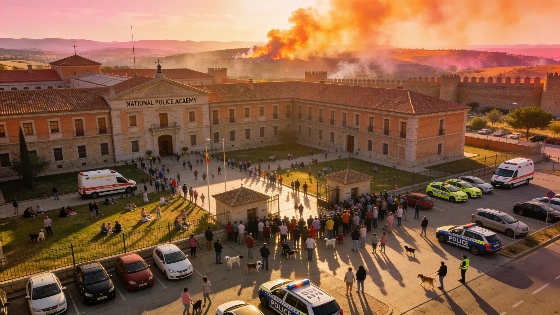
The National Police Academy in Ávila now houses hundreds forced out by wildfires. Authorities expect up to 1,500 evacuees by day's end. The facility offers private rooms, meals, and support for families and pets.
The National Police Academy in Ávila has rapidly transformed into Spain’s main emergency shelter as wildfires continue to force evacuations across the region. According to police sources cited by EL MUNDO, the academy is currently hosting 700 residents from seven villages, with numbers expected to more than double to 1,500 by the end of the day. Most arrivals are being transferred from smaller, less equipped centers that cannot provide the same level of comfort or capacity.
Unlike temporary shelters set up in sports halls or industrial buildings, the police academy offers individual or family rooms with private bathrooms, as well as organized meal services. Police officials emphasize that each case is handled individually, ensuring that families, elderly residents, and those with mobility issues receive appropriate accommodations. On Friday, dinner was delivered directly to rooms, while Saturday’s influx means meals will be served in two of the academy’s six dining halls.
The age range among evacuees is striking: the oldest guest is nearly 100 years old, while the youngest is a one-month-old infant. The shelter is also accommodating more than 50 dogs belonging to displaced families, highlighting the scale and diversity of the evacuation effort. The majority of current residents come from El Barraco, El Tiemblo, Burgohondo, Hoyo de Pinares, Cebreros, and Villanueva de Ávila—villages hardest hit by the advancing flames.
Authorities expect an additional 800 people to arrive throughout Saturday, many of whom are being moved from initial emergency shelters that lack adequate facilities for longer stays. The academy is also providing accommodation for volunteers from Galicia who have joined firefighting efforts, as well as Civil Protection personnel deployed to the area.
While the focus remains on immediate relief, the situation in Ávila reflects a broader challenge for Spanish authorities as wildfires become more frequent and severe. The rapid mobilization of resources and the use of institutional facilities like the police academy demonstrate a shift in emergency response strategies. For comparison, recent policy changes in Madrid aimed at accelerating housing construction have also sparked debate about how public infrastructure can be adapted in times of crisis, as seen in the latest legislative push to streamline urban planning.
Spain’s experience with large-scale evacuations has grown in recent years, with climate conditions contributing to longer and more intense wildfire seasons. The use of the National Police Academy as a shelter underscores the importance of flexible, well-equipped public spaces in managing emergencies. As the number of evacuees rises, authorities continue to monitor the situation and coordinate support for those affected, ensuring that vulnerable groups receive the care and stability needed during displacement.