José María Aznar calls on Alberto Núñez Feijóo to unite support across the political spectrum to prevent a system shift. The PP responds to controversy over alliances and the rapid granting of nationality to descendants of exiles.
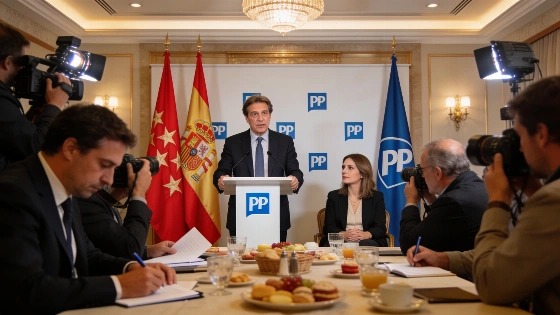
Former Prime Minister José María Aznar has publicly pressed opposition leader Alberto Núñez Feijóo to secure a sweeping “national majority” in the next general election, warning that Spain faces not just a change of government but a fundamental shift in its political system. Aznar’s remarks, delivered at a high-profile breakfast event in Madrid, come at a moment of heightened tension within the Partido Popular (PP) and amid ongoing debates about the party’s alliances and electoral strategy.
Speaking at the Mandarin Oriental Ritz, Aznar outlined his vision for a centrist coalition capable of attracting support from both the left and right. He argued that the stakes of the upcoming election go beyond routine political turnover, suggesting that the policies of Pedro Sánchez could lead to a deeper transformation of Spain’s institutional framework. Aznar did not mention Feijóo by name, but his message was clear: the PP leader must rally a broad base to counter what he described as a “system change.”
The timing of Aznar’s intervention is notable. In recent weeks, Feijóo has drawn criticism and scrutiny for his party’s tactical cooperation with Junts in several parliamentary votes. The PP’s willingness to align with regional parties has exposed internal divisions and raised questions about the party’s long-term strategy. This dynamic was highlighted when the Senate approved a PP motion for early elections, with Junts abstaining and the PNV voting against—a development that underscored the limits of the PP’s parliamentary maneuvering, as detailed in recent coverage of the Senate vote.
During the same event, PP parliamentary spokesperson Ester Muñoz addressed the controversy surrounding the party’s recent voting patterns and its stance on the so-called “ley de nietos.” Muñoz acknowledged that the PP has consistently supported granting Spanish nationality to descendants of exiles, but she questioned the government’s speed and transparency in implementing the measure. She raised concerns about the use of external companies and the rapid expansion of the electoral roll, suggesting that the process lacked sufficient oversight.
The debate over nationality comes as the PP distances itself from calls for a no-confidence motion against Sánchez, citing insufficient parliamentary support. Both Aznar and Feijóo have dismissed the viability of such a move, emphasizing instead the need for a compelling program that can unite a broad swath of voters. Muñoz also clarified that, despite occasional alignment with Junts and the PNV on specific issues, a formal agreement with Junts remains unlikely due to fundamental differences.
Contextually, the controversy over the nationality law and the party’s alliances reflects broader tensions in Spanish politics. The Ley de Memoria Democrática, passed in 2022, expanded eligibility for Spanish citizenship to descendants of those exiled during the Civil War and Franco era. While the measure was intended to address historical injustices, its implementation has sparked debate over electoral integrity and the role of external service providers in processing applications. The PP’s insistence on maintaining its legal challenge to the amnesty law at the Constitutional Court further illustrates the party’s cautious approach to recent legislative changes.
As Spain approaches another pivotal election cycle, the PP faces the dual challenge of consolidating its base while navigating complex relationships with regional parties and responding to government initiatives on historical memory and citizenship. The outcome of these debates may shape not only the party’s electoral prospects but also the broader trajectory of Spain’s political system in the years ahead.