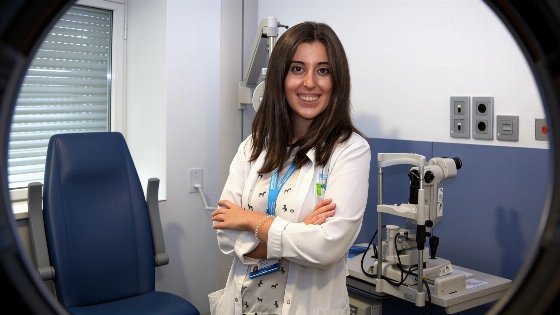
At just 33, Bárbara Burgos Blasco has been recognized as Spain’s leading young ophthalmologist. The Arruga 2026 award highlights her achievements in research, teaching, and clinical care at Hospital Clínico San Carlos.
Spain’s ophthalmology community has a new standout. Bárbara Burgos Blasco, just 33, now holds the Arruga 2026 prize. The Sociedad Española de Oftalmología gives this award to doctors under 40 who show outstanding skill in clinical work, teaching, and research. Few reach this level so early.
The society presented the award at its latest congress in Palma de Mallorca. This put Burgos Blasco in the national spotlight. The Arruga prize is one of the toughest to win in Spanish ophthalmology. Candidates are judged on clinical care, teaching, research, European training, and scientific publications with high impact. Burgos Blasco called the honor a team effort. “This award is not only an individual recognition, but also a tribute to all the professionals I have shared the journey with,” she said. “No achievement in medicine is completely individual.”
According to Europa Press, Bárbara Burgos Blasco works in the public Hospital Clínico San Carlos, specifically in the Unit of Ocular Surface and Inflammatory Diseases, which is part of Spain's national health system.
Her base is Hospital Clínico San Carlos in Madrid. She works in the Unit of Ocular Surface and Inflammation, a national reference center for complex eye surface reconstruction in Spain’s public health system. She trained as an ophthalmologist at this hospital. Later, she specialized in cornea and refractive surgery at the University of British Columbia in Vancouver, Canada.
Burgos Blasco’s academic record stands out. She tutors residents, works with the Universidad Complutense de Madrid, and leads doctoral theses and master’s projects. Her name appears on 177 scientific journal articles with impact factor. She has written 30 book chapters, both in Spain and abroad. She has given about 165 talks at scientific conferences. Her voice carries weight in her field.
Research is a core part of her work. She has joined national FIS research projects and clinical trials. She also reviews for many international journals. Her efforts have brought her several awards: Premio a la Excelencia para Residentes del Hospital Clínico San Carlos, Premio a Mejor Residente del Área quirúrgica del Colegio de Médicos de Madrid, Premio Fernando Martínez Sanz, and the Premio Extraordinario de Doctorado from the Universidad Complutense. Scientific societies have also recognized her conference presentations.
Sociedad Española de Oftalmología, as reported by Europa Press, awards the Arruga prize based on a comprehensive evaluation of a young specialist's professional trajectory, including clinical, teaching, and scientific achievements. The available confirmation does not include a full official protocol or jury list, so these details are based on published reports rather than primary official documents.
Hospital Clínico San Carlos has a long history with the Arruga award. Since 1947, eight of its doctors have won—more than any other hospital in Spain. Six still work in its ophthalmology department. This tradition adds meaning to Burgos Blasco’s win. She knows it. “The fact that other ophthalmologists from Clínico San Carlos have previously received this recognition makes it even more special.”
For Burgos Blasco, the Arruga 2026 award is both an honor and a new responsibility. The prize carries the name of a key figure in Spanish ophthalmology. She sees it as a push to keep growing and to help shape the future of her field.
In Spanish medicine, awards like this show the strength of public hospital training and the country’s ability to develop scientific talent. The Arruga prize’s strict standards mean only those with a proven record of excellence are chosen. Burgos Blasco’s path—built on research, teaching, and clinical work—shows how personal drive and strong institutions can set new benchmarks for Spain’s next generation of doctors.