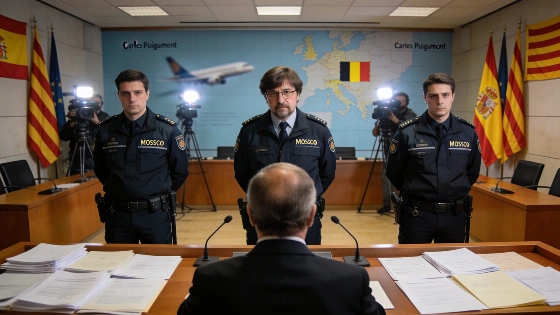
A Barcelona judge has formally charged three Mossos d'Esquadra officers over Carles Puigdemont's escape in August 2024. The case, previously closed, was reopened after an appeal. The officers now face possible trial for failing to act on a Supreme Court warrant.
Three Mossos d'Esquadra officers are now formally charged and face possible trial in Barcelona, following a judicial order that reopens the investigation into their alleged involvement in Carles Puigdemont's escape from the city in August 2024. The decision comes after the Audiencia de Barcelona overturned an earlier dismissal of the case, citing new evidence and the need for further legal scrutiny.
The judge in charge of the case, from Barcelona's Court of Instruction No. 24, has sent the proceedings to the Public Prosecutor and the private accusations, giving them ten days to submit their indictments. According to the court order, there are sufficient indications that the three officers coordinated their actions to facilitate Puigdemont's departure, despite an active arrest warrant issued by the Supreme Court. The document details how each officer allegedly took on specific roles, working together to prevent Puigdemont's detention and enable his escape.
Key to the court's reasoning are reports from the Mossos' Internal Affairs Division, which include images and video footage showing the officers closely surrounding Puigdemont during the incident. In some frames, the officers are seen physically assisting him through a crowd, a formation described by police as "encapsulamiento," typically used for the protection of high-profile individuals. The Audiencia de Barcelona concluded that the officers' presence at the scene was not coincidental, but rather part of a deliberate effort.
The case was reopened after appeals from Hazte Oír and Vox, who challenged the initial decision to provisionally close the investigation. The Seventh Section of the Audiencia found that the officers' actions could potentially constitute a violation under Article 408 of the Penal Code, which penalizes public officials who intentionally fail to pursue a crime, with disqualification from public office for six months to two years.
This development adds to ongoing legal and political tensions in Catalonia, where the actions of police and public officials during the region's independence crisis continue to face judicial review. The issue of accountability for public officials in politically sensitive cases remains a point of contention, as seen in other recent legal battles involving Catalan leaders. For example, disputes over the application of amnesty laws and the role of Spanish courts have also surfaced, as highlighted in the recent challenge by Oriol Junqueras and other former officials to the Tribunal de Cuentas, detailed in this related report.
In the broader context, Article 408 of the Spanish Penal Code is designed to ensure that public officials uphold their duty to enforce the law, particularly in cases involving high-profile fugitives. The legal process now moves to the next stage, where prosecutors and private accusers must decide whether to formally request a trial. The outcome could have implications for the standards of police conduct in politically charged situations and for the ongoing debate over the limits of official discretion in Spain's justice system.