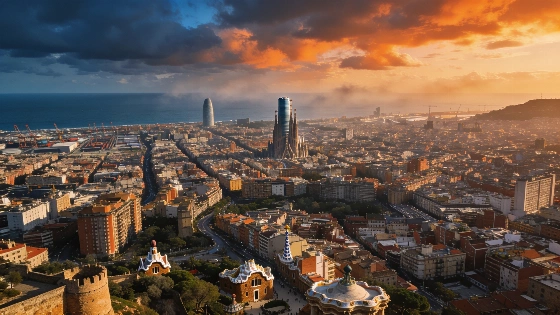
Barcelona's transformation as a global urban model is under scrutiny. The city’s fragmented governance and rising social demands highlight the urgent need for a metropolitan government. Key decisions loom for residents and policymakers.
Barcelona’s status as a global leader in urban innovation is once again in the spotlight as the city prepares for its role as World Capital of Architecture in 2026. A new exhibition at the Edit. G. Gili venue showcases a century of urban evolution and outlines ambitious plans for 2035, but also exposes a critical issue: the lack of a unified metropolitan government capable of addressing the city’s complex challenges.
While Barcelona’s pre- and post-Olympic urban policies—often referred to as the “modelo Barcelona”—have earned international recognition, the city’s governance remains fragmented. The dissolution of the Corporación Metropolitana de Barcelona (CMB) in 1987, following political tensions and the consolidation of power by the Generalitat under Jordi Pujol, left the metropolitan area without a strong, democratically legitimized authority. This institutional gap has become increasingly problematic as Barcelona’s metropolitan population has grown and diversified, now including over a million foreign-born residents from five continents.
Social and economic shifts have transformed the city’s landscape. The local economy has moved from a mixed industrial-services base to one dominated by new technology sectors, research, and a booming tourism industry. However, these changes have brought new pressures: housing shortages, strains on public health and education, and persistent inequalities between neighborhoods. The current management structure, led by the Área Metropolitana de Barcelona (AMB), is seen as necessary but insufficient to coordinate strategic planning and deliver essential services across the wider urban area.
Calls for a new metropolitan government are gaining traction. At the recent 15th anniversary of the AMB, President Illa emphasized the need to adapt metropolitan governance to the realities of today’s Barcelona, echoing the vision once championed by Pasqual Maragall. The debate is not just administrative—it is about ensuring that all residents have equitable access to housing, transport, and public services, and that their rights are protected in a rapidly changing city.
Symbolic moments from Barcelona’s urban history continue to resonate. The 1986 International Conference on Population and Urban Future, hosted in the city, brought together leaders from 79 major cities to discuss demographic and social trends. The event’s poster, designed by Antoni Tàpies, captured the enduring tension between civic demands and institutional power—a theme that remains relevant as Barcelona faces new challenges in governance and social cohesion.
As the city looks ahead to 2035, the need for a robust metropolitan authority is becoming urgent. Without it, experts warn that Barcelona risks falling behind in addressing critical issues such as affordable housing, public transport, and social integration. The upcoming municipal and regional elections are expected to put this question at the center of political debate, with many advocating for a broad, cross-level consensus to establish a true metropolitan government.
Barcelona’s experience is not unique in Europe. Many major cities have struggled to balance local autonomy with the need for coordinated metropolitan policies. According to recent analysis of Catalonia’s international ambitions, the region’s ability to host major events and manage urban growth depends on effective governance structures. For Barcelona, the next decade will be decisive in determining whether it can maintain its reputation as a model for urban innovation—or whether institutional inertia will hold it back.
For context, metropolitan governance refers to the political and administrative structures that manage urban areas extending beyond a single municipality. In Spain, the lack of strong metropolitan authorities has often led to fragmented planning and service delivery, especially in rapidly growing regions like Barcelona. As the city prepares for its next phase of development, the outcome of the current debate could shape the quality of life for millions of residents and set a precedent for other European cities facing similar challenges.