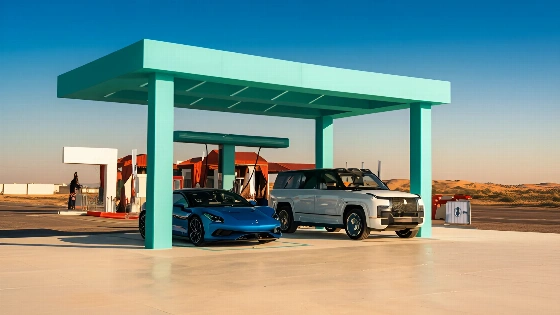
At the Abu Dhabi demonstration, a robotic arm found a car’s charging port, then opened its cover and inserted the connector without anyone handling the cable. Visual guidance and force feedback align the connection, automating the plug-in and charging process. BYD presented the installation as a system that links solar power and battery storage to Flash Charging. The site reportedly reached 1,000 kilowatts during the demonstration.
The automation is part of a wider operating concept. In BYD’s envisaged sequence, the driver exits and locks the vehicle, which then moves autonomously to an assigned charging bay. A visual guidance system and force sensors help align the arm for connection. The source describes this as an ideal scenario, rather than confirming that the process is available to customers.
BYD calls the integrated system SSC, or Solar-Storage-Charge, rendered in Spanish as Solar-Almacenamiento-Carga. It brings together the elements of the ‘Tres Sueños Eco’ vision set out by chairman Wang Chuanfu in 2006: generating clean energy from sunlight, storing that energy in batteries, then using it in electric vehicles.
The company says compatible vehicles using its second-generation Blade battery can charge from 10% to 70% in five minutes, or to 97% in nine minutes. BYD’s latest Flash chargers are rated at up to 1,500 kW, while the Abu Dhabi demonstration reached 1,000 kW. At temperatures as low as -30°C, BYD says the process takes 12 minutes. These are the company’s stated figures; the material provided does not identify a vehicle model or a test standard for them.
For Spain, the proposed network scale is the clearest practical detail. BYD plans 6,000 Flash Charging stations outside China by the end of 2027, with around 3,000 in Europe. The plan assigns 300 to Spain and 50 to Portugal. The importance of dependable charging for wider electric-car adoption also featured in earlier Nissan coverage. BYD says the SSC system will support its charging ecosystem as the network expands.