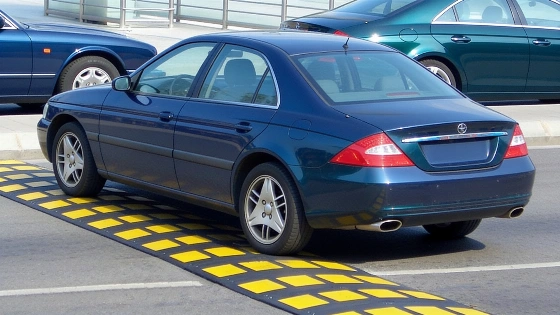
French rules cap speed humps at 10cm, yet an estimated 90% of the country’s roughly 450,000 devices fail to meet the standards. That puts around 400,000 outside the rules. These are estimates, not an audited national count: the Transport Ministry has said few road managers keep inventories precise enough to establish how many devices fail to comply.
Bringing them into compliance would cost between €5bn and €7bn. The proposed response is a decree revising rules for different traffic-calming devices and providing legal certainty for installations built under existing rules or technical guidance. The proposal would combine Decree No. 94-447 of 27 May 1994, which covers traditional speed humps and trapezoidal raised sections, with recommendations in a 2010 Cerema guide covering cushions and raised platforms. It aims to reduce the number of structures requiring costly reconstruction, not approve every existing installation automatically. Transitional measures are also under consideration, giving road authorities time to bring devices into line. The decree has not been reported as adopted, so the existing framework remains in force.
French standards restrict installation to roads with a 30km/h speed limit. Traffic must not exceed 3,000 vehicles a day, and public transport must not use the road. The debate covers traditional humps and trapezoidal sections, as well as cushions and platforms. Some motorists have complained that high humps force drivers to brake or risk damaging a car’s underside, according to comments reported by Radio France. Motorists’ associations have also warned that easing technical requirements could leave hazardous or excessively severe structures in place.
Local authorities face different costs when removing or redesigning these installations. In Solliès-Pont, in the Var, some humps were removed and replaced with bends or other traffic-calming arrangements. Florent Chollet, the municipality’s director of technical services, said a small raised platform could cost several thousand euros. Redesigning an entire multi-lane intersection could cost substantially more.
For context, RACE’s compact-car repair estimate put potential bills at about €1,000 to €14,000. Those figures do not relate specifically to damage caused by speed humps.
Spain has a separate technical instruction, approved by Order FOM/3053/2008 of 23 September, for speed-reduction devices on the State Road Network. It distinguishes raised pedestrian crossings from two other types: built “lomo de asno” humps and prefabricated devices. Reported maximum heights are 10cm for raised pedestrian crossings, 6cm for built humps and 3cm for prefabricated devices. For the raised-section design covered by the instruction, the maximum length is 4m and the maximum height is 10cm. The instruction also bars installation on stretches with average daily traffic above 5,000 vehicles. Roads with more than two traffic lanes are excluded unless an impassable median separates the directions. Spanish reporting also gives a spacing range of 50 to 200 metres between consecutive reducers.
The distinction matters for local streets. Order FOM/3053/2008 applies to the state network. Municipalities may use it as a reference, but it does not directly govern every municipal street or industrial estate.