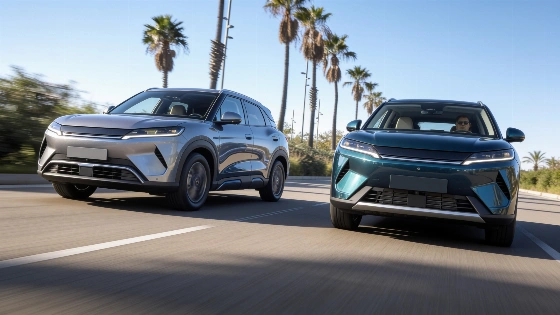
BYD has surpassed MG in monthly sales, signaling a major shift among Chinese car brands in Spain. With just over 2,000 units separating them for the year, the race for the top spot is closer than ever.
BYD has taken the lead from MG as the best-selling Chinese car brand in Spain, marking a significant turning point in the country's automotive landscape. According to the latest sales data for July 2026, BYD registered 3,899 vehicles, outpacing MG's 3,688 units for the month. This shift comes after years of MG dominance, and now only 2,066 units separate the two brands in year-to-date figures.
The numbers highlight a dramatic change in momentum. BYD's sales soared by 80.7% compared to July 2025, while MG saw a slight decline of 0.4% over the same period. The trend is even more pronounced in the cumulative results for 2026: BYD has more than doubled its registrations year-on-year, posting a 116.6% increase, while MG's total has slipped by 1.3% compared to the first seven months of last year.
This rapid growth is driven by models like the Atto 2 and Seal U, which have found strong demand among Spanish buyers. MG initially benefited from early market entry and brand recognition, offering affordable vehicles at a time when price sensitivity was high. However, BYD's position as China's largest car manufacturer is now translating into real gains in Europe, with Spain emerging as a key battleground.
Despite these advances, Chinese brands have yet to break into Spain's overall top 10. The market remains dominated by established European, Japanese, and South Korean names, with Toyota leading the pack at 64,387 units so far in 2026. Volkswagen, Seat, Renault, Kia, Peugeot, Dacia, Hyundai, Mercedes, and BMW round out the top ten. MG, with 28,825 units, is just 1,707 vehicles behind BMW, while BYD, at 26,759, is closing in as well.
Other Chinese manufacturers are also gaining ground. Brands like Jaecoo (8,087 units, +56% year-on-year), Leapmotor (3,691 units, +189%), Omoda (15,066 units, +105%), Geely (1,383 units), and Changan (2,360 units) are steadily increasing their presence. This collective growth means that Chinese brands now account for more than 50,000 new registrations between January and July 2026.
Meanwhile, several established brands are experiencing declines. Citroën is down 5.7%, Jeep 0.8%, Alfa Romeo 12.5%, and Abarth a steep 88.5%. Dacia, Ford, Hyundai, Land Rover, Nissan, and Renault have also posted negative results, reflecting a broader shift in consumer preferences.
The competition between Chinese and European automakers is intensifying, not only in Spain but across the continent. The arrival of new models and aggressive pricing strategies are reshaping the market, as seen in the growing rivalry between Chinese and German brands. For example, the recent comparison of premium electric vehicles in Europe, such as the Zeekr 7GT and BMW iX3, highlights how innovation from China is challenging established players.
As the year progresses, the gap between MG and BYD is expected to narrow further. If current trends continue, BYD could soon claim the title of Spain's leading Chinese car brand, signaling a new era in the country's automotive market.