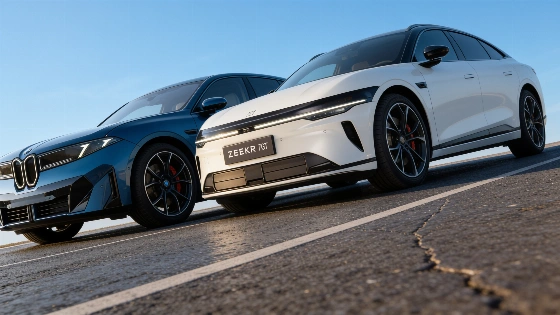
The Zeekr 7GT enters Europe with aggressive pricing and advanced tech, directly confronting the established BMW iX3. How do these two electric contenders compare in design, performance, and value?
Zeekr’s 7GT has arrived in Europe, setting its sights on the BMW iX3 and forcing a direct comparison between a bold Chinese newcomer and a pillar of German automotive tradition. Both target drivers seeking premium electric vehicles, but their approaches reveal a changing landscape in the segment.
Design and Dimensions
The Zeekr 7GT and BMW iX3 occupy the upper mid-size segment, yet their proportions differ. The Zeekr 7GT measures 4,817 mm in length, 1,910 mm in width, and 1,456 mm in height, with a 2,900 mm wheelbase. The BMW iX3 is slightly shorter and taller, at 4,782 mm long, 1,895 mm wide, and 1,635 mm high, with a 2,897 mm wheelbase. Luggage space also sets them apart: the Zeekr offers 456 liters, while the BMW provides a more generous 520 liters.
Powertrains and Performance
Zeekr’s lineup is broader, offering three versions. The entry-level 7GT Core features rear-wheel drive, a single 421 hp (310 kW) motor, and a 75 kWh LFP battery, delivering up to 519 km WLTP range. The Long Range RWD variant swaps in a 100 kWh NMC battery, extending range to 655 km. At the top, the Privilege AWD combines two motors (165 kW front, 310 kW rear) for 646 hp and 710 Nm, sprinting from 0 to 100 km/h in 3.3 seconds and reaching 210 km/h. Charging is a highlight: up to 450 kW DC with the LFP battery, 420 kW with NMC, and 22 kW AC, allowing a full charge in under five hours.
BMW’s iX3 range is more focused. The iX3 40 uses a 320 hp (235 kW) rear motor and an 82.6 kWh battery, achieving 566–637 km range and 0–100 km/h in 5.9 seconds. The i3 50 xDrive adds all-wheel drive and two motors for 469 hp (345 kW), cutting the sprint to 4.9 seconds and boosting range to 717–805 km with a 108.7 kWh battery. Both support fast DC charging—up to 300 kW for the iX3 40 and 400 kW for the i3 50 xDrive—reaching 80% in just 21 minutes.
Equipment and Features
The BMW iX3 comes well-equipped: LED headlights and taillights with high-beam assist, automatic tailgate, flush electric door handles, folding and illuminated mirrors, BMW Operating System X, Panoramic iDrive and Vision, full smartphone integration, virtual assistant, online navigation, dual-zone climate with heat pump, power front seats with memory, Hill Descent Control, lane keeping and emergency braking assistants, and more.
The Zeekr 7GT counters with 19-inch alloy wheels, Matrix LED headlights, panoramic glass roof, electric tailgate, heated and folding mirrors, power front seats with four-way lumbar, heated leather steering wheel, dual-zone climate, ambient lighting, a 15-inch OLED central display, 13-inch HD digital cluster, Apple CarPlay and Android Auto, wireless phone charging, facial recognition, adaptive cruise, emergency braking, lane keeping and change assist, traffic sign recognition, parking assistant, and a 360-degree camera system.
Pricing and Value
Price is where the Zeekr 7GT makes its boldest statement. Starting at €44,840, it undercuts the BMW iX3’s €63,650 entry point by nearly €20,000. This gap is significant, even in the premium segment, and positions Zeekr as a disruptive force for buyers prioritizing value and technology over brand legacy.
Who Comes Out Ahead?
Both models target drivers who want a premium electric experience, advanced tech, and zero-emission credentials. The Zeekr 7GT offers more power and equipment for less money, though its entry version trails the BMW in range and boot space. The BMW iX3, meanwhile, leans on its established reputation and slightly superior practicality. For many, the decision may come down to whether the appeal of a historic badge outweighs the Zeekr’s aggressive pricing and feature set.
This contest reflects a broader trend: Chinese brands are no longer just following European standards—they’re setting new ones. As seen with other recent launches, such as the arrival of XPeng’s G9 with its record-breaking charging speeds (XPeng’s G9 challenges rivals in Spain), the competition in Europe’s premium EV market is only intensifying.
For context, Zeekr is part of Geely, which also owns Volvo and Polestar, giving it access to established engineering and supply chains. BMW’s Neue Klasse platform, meanwhile, signals a major shift for the German brand, with the iX3 as its first step. The coming years will show whether European loyalty or Chinese innovation wins over the next generation of electric car buyers.