Authorities in the Canary Islands will distribute thousands of certified eclipse glasses and set up eight official observation sites for the partial solar eclipse on August 12. The event will last nearly two hours and include accessibility features.
The Canary Islands are finalizing preparations for a rare astronomical event: a partial solar eclipse visible across the archipelago on August 12. Regional authorities, led by the Ministry of Tourism and the Museo Elder, have announced a coordinated plan to ensure safe and accessible viewing, including the distribution of up to 3,000 free eclipse glasses and the creation of eight official observation points, one on each island.
The eclipse will begin at approximately 18:55 and reach its peak at 19:55, when the Moon will cover 77% of the Sun as seen from the islands. The phenomenon will last nearly two hours, offering residents and visitors an extended opportunity to witness the event. According to the Museo Elder, the unique geographic position of the Canary Islands allows for a particularly clear and prolonged view, with the Sun taking on a distinctive crescent shape at maximum coverage.
Officials stress that the eclipse can be observed safely from any location in the Canary Islands, including rooftops, beaches, and public spaces. Weather forecasts predict clear skies, and the event will occur during daylight, minimizing the impact of light pollution. The eight designated 'cosmic watchtowers'—set up in locations such as Caleta de Sebo (La Graciosa), La Santa (Lanzarote), Poblado de Atalayita (Fuerteventura), and Tejeda (Gran Canaria), as well as sites in Tenerife, La Gomera, La Palma, and El Hierro—will offer expert guidance and distribute protective glasses.
Authorities are urging the public to avoid mass gatherings at these official points, emphasizing that the eclipse is visible from anywhere on the islands. To prevent overcrowding, local governments, civil protection, and law enforcement are coordinating logistics and safety protocols. The extended duration of the eclipse allows for staggered viewing, reducing the need for large groups to converge at specific sites.
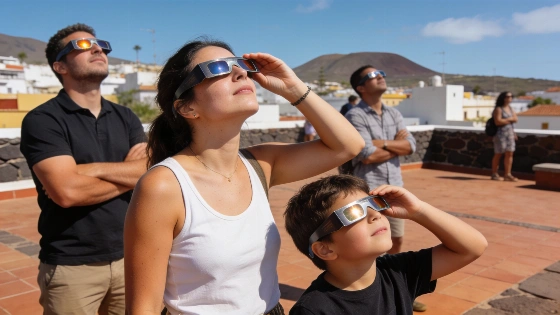
Safety remains a top priority. Experts warn that even with certified glasses, direct viewing of the Sun should be limited to 30 seconds at a time, with breaks of at least 15 minutes between observations. The Museo Elder advises users to put on eclipse glasses with their backs to the Sun and to remove them only after turning away. For children, glasses should be held firmly to prevent slipping, and those who wear prescription glasses should place the eclipse glasses over them. Only glasses marked with the EN ISO 12312-2:2015 standard are considered safe for solar observation.
In addition to the glasses distributed at observation points and the museum itself, the ONCE organization will hand out 125,000 certified glasses through its 1,200 vendors across the Canary Islands. This broad distribution aims to ensure that as many people as possible can participate safely in the event.
Accessibility is also a focus. Some observation sites will be equipped with LightSound devices, which convert changes in light into sound, allowing people with visual impairments to experience the eclipse in real time. This initiative, developed in collaboration with ONCE and the Eclipse Inclusivo project of the CSIC, seeks to make the event inclusive for all residents and visitors.
While the eclipse is a highlight for the Canary Islands, it is part of a broader trend of public engagement with science and astronomy in Spain. Similar to how local authorities in Barcelona have implemented special measures for public festivals, as seen in the recent preparations for the Gràcia Festival, the Canary Islands are prioritizing both safety and accessibility for this major event.
Solar eclipses are rare and often draw significant public interest. The next comparable event visible from Spain is not expected for several years, making this August's eclipse a unique opportunity for residents and tourists alike. The emphasis on certified protection, expert guidance, and inclusive technology reflects a growing commitment to public safety and scientific outreach in the region.