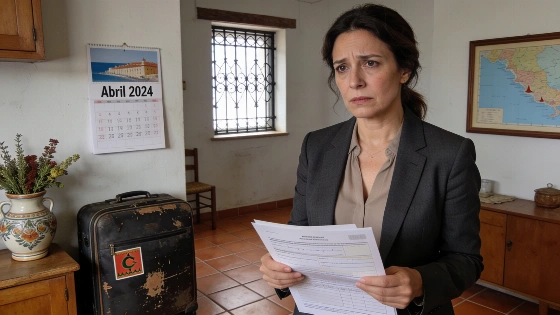
A woman in Catalonia must return over €32,000 after Social Security found she spent nearly two years in Morocco and exceeded income limits. The court upheld the pension’s cancellation, highlighting strict residency and financial rules for non-contributory disability benefits.
Social Security authorities in Catalonia have revoked a non-contributory disability pension and demanded the return of €32,857.20 after discovering the recipient spent a total of 680 days in Morocco between 2018 and 2021. The Tribunal Superior de Justicia de Cataluña (TSJC) confirmed the decision, ruling that both prolonged absences from Spain and excess household income justified the cancellation.
The woman, who had received the benefit since December 2013, was entitled to a monthly payment of €604.20 plus a small supplement. She also collected a Moroccan pension of €96.68 per month. According to the court’s findings, she exceeded the permitted 90 days abroad each year, with stays of 135 days in 2018, 136 in 2019, 260 in 2020, and 149 in 2021. Spanish law requires continuous residence for non-contributory disability pensions, allowing only brief absences unless justified by illness.
Residency and Income Limits Breached
The TSJC’s ruling cited Article 10.2 of Royal Decree 357/1991, which states that absences from Spain must not surpass 90 days per calendar year unless medically justified. The woman’s repeated and extended stays in Morocco led to the loss of her residency status for benefit purposes. As a result, Social Security set the effective date for pension termination as June 1, 2018, and calculated the overpaid amount at €32,857.20.
In addition to the residency violation, the court found that the woman’s household income far exceeded the legal threshold. In 2021, her family unit reported €73,291.08 in income—more than double the €33,835.20 limit for a three-person household with direct family ties. Most of this income came from a disability pension received by her cohabiting daughter, along with the claimant’s Moroccan pension.
Pandemic Restrictions Not a Valid Excuse
The claimant argued that COVID-19 border closures in 2020 made it impossible to return to Spain within the legal timeframe. However, the court determined that, while the pandemic complicated travel, there was no evidence of an absolute inability to return. The judges noted that Spanish residents were permitted to re-enter the country by land, air, or sea throughout the health crisis. Furthermore, the woman had already breached the absence limit in 2018 and 2019, and again in 2021, independent of pandemic restrictions.
Obligations for Pension Recipients
Recipients of non-contributory disability pensions are required to notify authorities within 30 days of any changes in residence, household composition, or financial situation. Occasional travel abroad does not automatically result in loss of benefits, but exceeding the annual absence limit or surpassing income thresholds can trigger suspension or cancellation. The TSJC clarified that the €32,857.20 figure represents the total amount to be repaid, not the income ceiling itself.
This case underscores the importance of strict compliance with residency and income rules for social benefits in Spain. Similar to how Spanish law requires formal tax declarations for gifts within families, as discussed in this analysis of tax obligations on family gifts, the authorities maintain close oversight of eligibility for public assistance. For those relying on non-contributory pensions, even unintentional breaches can have significant financial consequences.