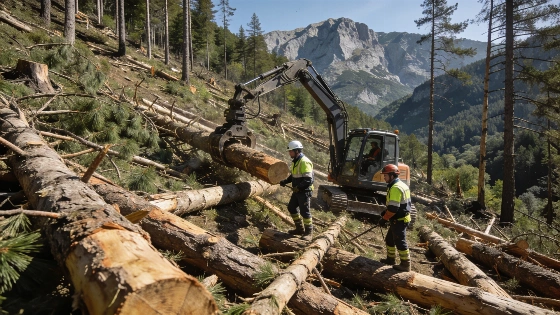
Over 44,000 tons of fallen timber remain in Catalonia’s Pyrenees after severe storms. Bureaucratic hurdles and a shortage of forestry firms stall urgent cleanup. Local officials now warn of pest outbreaks and fire risks.
Months after severe winter storms, tens of thousands of fallen trees still cover the slopes of Ripollès, Berguedà, and Cerdanya in Catalonia’s Pyrenees. The backlog has reached 44,000 tons—three times the original estimate—raising concerns about pest outbreaks and wildfire risk as colder weather approaches. The Department of Agriculture calls this one of the largest accumulations of storm-damaged timber in recent memory.
Efforts to clear the debris have slowed to a crawl. Local officials and forestry managers point to a mix of lingering snow, slow administrative processes, and a shortage of companies able to handle the work. In some places, the landscape is a tangle of trunks, and extraction teams have to move carefully. The Catalan government says that releasing public forest assets for auction can take months, which has delayed cleanup even further.
In March, the Catalan government declared a state of forest emergency in the affected Pyrenean regions, enabling municipalities to request extraordinary funding for cleanup efforts.
Ripollès has been hit hardest, with 845 hectares affected and 39,000 tons of timber still waiting to be cleared. In Cerdanya, 146 hectares and 4,700 tons are concentrated around Aransa and Lles. Berguedà faces 125 hectares and 2,070 tons, according to the Department of Agriculture. The best time for clearing—March to June—has already passed, and in many towns, timber contract auctions only started in July. The Generalitat reports that these delays have made it harder to act in time, increasing the risk of pest problems.
Gerard Vila, technical director at the Consorcio de Espacios de Interés Natural (CEIN) in Ripollès, describes the process as a drawn-out struggle. Teams had to map the damage and calculate volumes, while the Generalitat needed to formally release public forest assets for auction. Some sites were so hard to reach that over two kilometers of new tracks had to be built. In certain areas, cleanup was abandoned because of high costs or safety concerns. The regional forestry association says the lack of available contractors has been made worse by similar storms elsewhere in Spain, which have also tied up heavy machinery.
Marc Figueras, head of forestry operations at Lignia Forestal, says there is a severe shortage of experienced contractors in Catalonia. His company sent 25 staff and nearly a dozen machines—some worth over €700,000—to tackle the Ripollès backlog. The region usually produces about 6,000 tons of timber a year; this year, the volume is five times higher, overwhelming local capacity. La Vanguardia notes that the sudden demand for forestry services has driven up costs and made it harder to find skilled workers.
In 2022, Catalonia experienced its worst wildfire season in over a decade, with more than 26,000 hectares burned, underscoring the urgent need for proactive forest management and rapid response to storm damage.
At first, mayors worried the fallen wood would fuel wildfires. Now, the focus has shifted to bark beetle outbreaks, since dead timber is a breeding ground for pests that can damage healthy forests. The need to finish extraction before winter adds pressure, but progress is uneven: some forests have had up to 70% of debris cleared, while others are far behind. The Spanish Ministry for Ecological Transition notes that bark beetle infestations in unmanaged storm debris have caused major losses in other parts of Europe, making timely removal crucial.
In August, the Catalan government and the four provincial councils agreed on a new forest management plan to help towns and reduce fire risk as temperatures rise. The plan aims to thin 2,000 hectares a year, create buffer zones, and speed up administration. Whether these steps can overcome the problems exposed by this year’s storms is still unclear. Experts at the Forest Science and Technology Centre of Catalonia say that steady investment and better coordination between agencies are needed to prevent future crises like this one.
The situation in the Pyrenees shows a long-standing weakness in Spain’s forest management: when disaster hits, limited resources and slow bureaucracy leave communities exposed for months. Without a fast, well-funded response, the region risks turning natural disasters into long-term ecological and economic problems. Preparation and investment in forestry infrastructure are now essential to protect Spain’s mountain forests.