The Catalan Parliament has ended its inquiry into DGAIA scandals without naming political culprits. Most parties backed the report, but Junts opposed it. The case exposed deep flaws in child protection oversight.
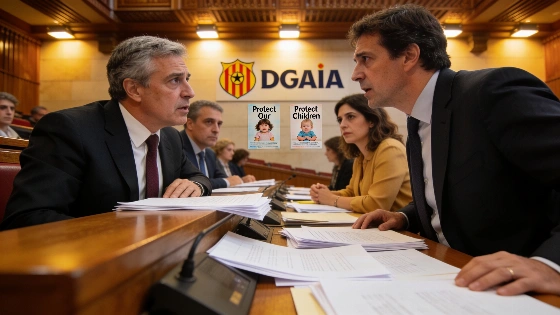
The Catalan Parliament has formally ended its investigation into the high-profile scandals surrounding the Dirección General de Atención a la Infancia y la Adolescencia de la Generalitat (DGAIA), closing the case without attributing political responsibility. The final report, debated and voted on in the last session before the summer break, acknowledges irregularities in the agency’s management but stops short of holding any political figures accountable. The outcome was secured by the votes of the Socialists, Esquerra, and Comuns, while Junts broke ranks and voted against the conclusions.
The DGAIA has faced intense scrutiny since the start of the current legislative term, following two major scandals. First, it emerged that a minor under the agency’s care had been subjected to sexual violence and exploitation. Later, the Sindicatura de Cuentas highlighted serious irregularities in the outsourcing of services for children in state care. These revelations prompted the Parliament to launch a special commission, led by the PSC, which produced a 100-page report with recommendations and findings now at the center of political debate.
Despite the commission accepting 75% of Junts’ proposals, the party’s representatives argued that the process failed to meet its objectives. Junts deputy Enatu Domingo accused the majority of using the report to “cover up their own failings,” criticizing the lack of political accountability for planning failures and service irregularities. She also pointed to the recent resignation of former minister Mónica Bravo as a factor contributing to ongoing instability in the department.
During the session, Raúl Moreno, the new head of the department and former deputy to Bravo, was present for the debate. The Comuns distanced themselves from parts of the report, highlighting that the system has operated in a state of “permanent emergency” for over a decade. They criticized the lack of oversight in the mass outsourcing of services, a practice justified by the surge in unaccompanied foreign minors. Chronic understaffing and low pay have led to high turnover among frontline professionals, with direct consequences for the children in care. Comuns deputy Núria Lozano described the report as more diagnostic than transformative, arguing it falls short of ensuring real rights for minors.
Other parties, including CUP, Vox, PP, and Aliança Catalana, also voted against the report, albeit for different reasons. The two far-right parties rejected any recommendations for improvement, framing the commission’s work as a “charade” that masks the impact of excessive immigration on resources for vulnerable Spanish children. CUP’s Pilar Castillejos lamented the rejection of her proposal for an external audit and a deeper investigation into the role of certain social organizations. PP spokesperson Lorena Roldan specifically named Fundación Mercè Fontanilles and Fundació Resilis as entities warranting further scrutiny.
PSC deputy Mónica Ríos defended the commission’s work, emphasizing that the process has made Parliament more aware of both the weaknesses and strengths of the DGAIA. She stressed that the report avoids simplistic conclusions and seeks to identify root causes to guide future reforms.
The challenges facing child protection services in Spain are not unique to Catalonia. In Madrid, for example, the specialized juvenile violence court has struggled with a backlog of thousands of cases due to staff shortages and limited resources, as detailed in a recent report on Madrid’s overwhelmed youth court. These systemic issues highlight the broader difficulties in safeguarding vulnerable minors across the country.
Spain’s child protection system relies heavily on regional agencies like the DGAIA, which are responsible for both preventive and emergency interventions. The recent parliamentary inquiry in Catalonia underscores the complexity of balancing urgent care needs, resource constraints, and political oversight. While the commission’s report brings some transparency to longstanding problems, the absence of clear political accountability leaves open questions about how future crises will be managed and whether meaningful reforms will follow.