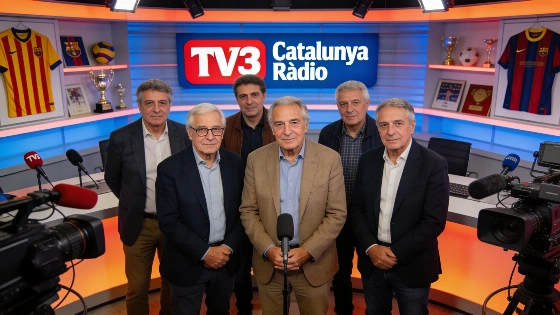
A generation of Catalan sports journalists is stepping down from TV3 and Catalunya Ràdio, marking a shift in how sports are covered across the region. Their legacy is shaping the next era of sports media.
Several of Catalonia’s most influential sports broadcasters are retiring from TV3 and Catalunya Ràdio, reshaping the region’s sports media field. Their departures come as the industry contends with digitalization and social media’s rise, alongside the growing influence of production companies and broadcasting rights holders. A report published by La Torre de Barcelona on 20 October 2026 described the retirements as part of a generational transition at TV3, involving professionals who helped build the broadcaster’s history. Public media is adapting to stay relevant and engage audiences across its platforms.
Among the most impressive figures stepping down is Lluís Canut, whose career has been closely tied to the evolution of sports coverage in the region. Known for his encyclopedic memory and precise recall of basic moments in Catalan sports, Canut recently co-authored the book La vida en directe with Víctor Lavagnini. The book traces Canut’s journey and pays tribute to journalists who shaped the field, including Àlex J. Botines and Fernando Borderías. It also honors Quim Regàs. Their collective work established a standard for sports reporting that has influenced generations.
The retirement coverage names Lluís Canut and Jordi Robirosa, along with Pere Escobar and Isabel Bosch. It also lists Imma Pedemonte and Xavier Bonastre, Quique López Vilalta and Toni Real, as well as Eduard Boet and Arcadi Alibés among the veteran TV3 professionals stepping down. Their departures matter especially in sports, where familiar presenters and commentators have built long-running connections with audiences and the events they cover.
TV3 has long positioned itself as a basic broadcaster of major sporting events in Catalonia, from the Grand Départ of the Tour de France to motorsport at Montmeló and the UEFA Women’s Champions League, where FC Barcelona often takes center stage. Its focus on Barça has sometimes drawn criticism from rival clubs and fans, who argue that it overshadows the region’s broader sporting diversity. Canut and Alibés, along with Xavier Bonastre and Quique López Vilalta, have become closely associated with particular sports and competitions. The same is true of Imma Pedemonte and Robirosa.
Sports continues to attract large audiences across the 3Cat group. On 20 October 2026, Zona Champions, broadcast simultaneously on TV3 and Esport3, averaged 165,000 viewers and a 14.4% share at 11 p.m. after FC Barcelona’s defeat. That day, Telenotícies Migdia averaged 446,000 viewers and a 31.9% share. The figures show how sports coverage draws appointment viewing alongside the group’s regular news programming.
The sports offer also reaches beyond live coverage and analysis. The football-focused comedy programme Crackòvia is scheduled to return to the 3Cat platform on 26 October 2026, nine years after its previous run. The planned comeback reflects football’s continuing place in the broadcaster’s entertainment programming, as well as in its journalism.
Most of these journalists began their careers at Catalunya Ràdio before moving to TV3, helping create a distinct Catalan sports media identity. The integration of the outlets under the 3Cat brand has prompted debate, particularly among Catalunya Ràdio staff who have long valued the radio service’s editorial independence. The transition reflects broader changes in public media, from new technology to organizational shifts. The broadcaster is also trying to reach audiences through services tailored to different age groups and platforms.
The Catalan Corporation of Audiovisual Media has described EVA as its principal offer for audiences aged 16 to 23, while the 3Cat platform performs strongly among people aged 40 and over, information from reporting by Ara. TV3 remains a natural destination for older viewers. The same report put iCat’s daily audience at 30,000 in the latest summer EGM, up from 20,000 a year earlier, a 50% increase. The corporation plans to begin transforming iCat into a video-inclusive channel in the second half of January, adapting existing programmes for social networks and the 3Cat platform.
Digital distribution is increasingly complementing television’s mass reach. For the 2025-2026 New Year’s Eve broadcast, TV3 recorded a 44.4% share during the first minute and attracted more than one million viewers in Catalonia, while 3Cat registered more than 51,000 unique connected devices. Reported audience figures for the broadcast over three seasons were 36.1% and 916,000 viewers in 2025-2026. In 2024-2025, the figures were 32.2% and 824,000 viewers. For 2023-2024, they were 36.1% and 924,000 viewers.
The emergence of Catalan-language sports media in the early 1980s was a basic moment. Figures such as Joaquim Maria Puyal set high standards for professionalism and rigor, establishing a tone and style that resonated with audiences during the era of the Dream Team and the Barcelona Olympics. Canut further shaped the audiovisual narrative of Catalan sports coverage through programmes such as Basquetmania and Efectivament. Gol a Gol also formed part of that work.
As veteran journalists retire, their influence remains visible in the next generation of reporters and producers working across TV3 and Canal 33, as well as Esport3 and 3/24. The documentary El fitxatge, produced by Canut as a farewell to TV3, examined Johan Cruyff’s impact on FC Barcelona. The sector’s evolution is also reflected in forthcoming publications, including a new book on radio journalism by Santi Carreras. Canut continues to appear in outlets such as La Vanguardia and Mundo Deportivo.
The challenges faced by prominent sports figures in Spain extend beyond journalism. The financial and personal struggles of tennis legend Arantxa Sánchez Vicario, detailed in this recent report, highlight broader pressures in Spanish sports.
Diagnosed with Parkinson’s disease in 2016, Canut continues to advocate for awareness of the condition, drawing parallels with his idol Muhammad Ali. His latest book is both a memoir and a platform for discussing the realities of living with Parkinson’s, reflecting the personal and professional ability to recover that has defined his career. The retiring generation’s standards and values continue to shape Catalan sports journalism as the industry adapts to new challenges.
Since the 1980s, sports journalism in Catalonia has played a basic role in promoting the Catalan language and identity. TV3 and Catalunya Ràdio became central platforms for covering local and international sports, often focusing on FC Barcelona as a symbol of regional pride. The expansion of digital platforms and the consolidation of media brands such as 3Cat reflect broader changes in European public broadcasting, where preserving editorial independence and adapting to audience habits remain basic challenges.