Catalonia will restrict truck traffic and deploy 700 police for the total solar eclipse. Authorities expect local travel surges and urge use of public transport. Special trains and parking rules are in place.
Catalonia is set to enforce strict traffic controls this Wednesday as the region braces for a rare total solar eclipse, with authorities moving to prevent gridlock on major routes toward the south. The Servei Català de Trànsit (SCT) has announced a ban on truck traffic heading from Martorell toward Ponent, Camp de Tarragona, and Terres de l’Ebre between 17:00 and 22:00, aiming to keep key corridors clear for thousands expected to travel to prime viewing areas.
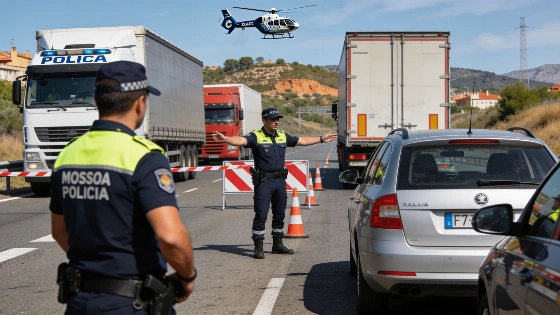
To manage the anticipated surge, Mossos d’Esquadra will deploy 700 officers, including 180 focused solely on traffic, and a helicopter for aerial monitoring. The operation will concentrate on the AP-7 and A-2 motorways, as well as access points to towns hosting eclipse events and designated parking. Coordination with local police and Agents Rurals is also planned, with the latter monitoring wildfire risks due to increased roadside activity.
Despite the scale of the operation, SCT director Ramon Lamiel noted that most eclipse-related travel is expected to be local, with around 60% of vehicles in observation zones coming from within the same comarca. Still, the risk of bottlenecks remains high in the hours before and after the eclipse, especially as thousands may leave observation points simultaneously. Authorities stress the importance of using only official parking areas and avoiding roadside stops that could block emergency access.
Trànsit is urging residents to avoid driving if possible, recommending public transport or walking to observation sites. For those traveling from Martorell to Lleida, the AP-2 is advised, while the AP-7 is suggested for routes to Camp de Tarragona and Terres de l’Ebre. A special Renfe train on the R16 Rodalies line will depart Tortosa at 21:56, stopping at several towns before reaching Barcelona’s Estació de França at 00:51, to help manage the post-eclipse exodus.
In total, about 20 official observation points have been set up across Catalonia. The authorities are also reminding drivers to check their vehicles before setting out and to stay updated on traffic conditions throughout the day. The main goal is to prevent congestion that could hinder both mobility and emergency response, particularly during the mass departure after the eclipse.
Similar large-scale preparations were seen during previous astronomical events in the region. For context, a recent report on eclipse planning in Catalonia highlighted the challenges of managing tens of thousands of visitors and the need for coordinated security and transport measures.
The total solar eclipse is a rare occurrence for Catalonia, with the next event of this kind not expected until 2180. The combination of traffic restrictions, police deployment, and public transport reinforcements reflects the authorities’ determination to ensure safety and minimize disruption during this unique astronomical phenomenon.
Solar eclipses have historically drawn large crowds to specific viewing locations, often leading to significant traffic and logistical challenges. In Spain, such events prompt coordinated action between regional and local authorities, transport operators, and emergency services. The focus on preventing road congestion and ensuring emergency access is particularly acute in rural areas, where infrastructure may be limited. The use of special trains and designated parking is a common strategy to reduce private vehicle use and streamline crowd movement. As with other major public events, the success of these measures depends on public cooperation and timely communication from officials.