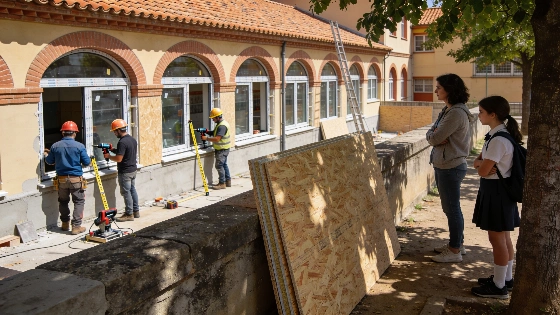
Catalonia will invest 2.5 billion euros to modernize every public school by 2031. The first 100 schools will receive air-conditioning or insulation upgrades. The plan aims to address teacher unrest and aging infrastructure.
The Catalan government, led by Salvador Illa, has announced a 2.5 billion euro plan to adapt every public school in the region to climate challenges within five years. Presented in Barcelona amid rising tensions with teachers and the threat of strikes, the Plan Actualiza Clima aims to upgrade 2,530 schools. RTVE reports that the first phase will focus on 100 priority sites, with a budget of 100 million euros. The Generalitat expects to mobilize the full 2.5 billion euros by 2030 to 2031.
During the current legislative term, 100 schools and institutes will receive upgrades. Not every building will get air conditioning; some will instead have new windows or better insulation. The initial work, budgeted at 100 million euros, is scheduled to finish by summer 2028, in line with the end of the school year and the legislature. Each school is expected to receive about one million euros on average. Local councils are expected to manage much of the work and cover costs upfront, while the Generalitat reimburses them gradually until 2037. La Vanguardia reports that the first 100 schools should be fully adapted by the 2027/2028 academic year. It also reports that, from 2027, local authorities will be able to carry out and initially finance the work using their own resources or ICF loans, with the Generalitat reimbursing the costs.
The announcement comes as negotiations between teachers’ unions and the government have stalled, and new protests remain possible. Illa’s speech at the Museu Marítim was timed just before the Asamblea Educativa is expected to announce its next steps. The government says action is underway after years of neglect. RTVE and EFE report that the new school year in Catalonia began with teacher strikes and protests, alongside demands for more resources, including climate adaptation for schools.
The plan also covers 51 public residences, with 580 million euros set aside for similar climate upgrades. Officials present the investments as a response to the climate emergency and an effort to address years of underfunding in public infrastructure. Recent setbacks in education, including the fallout from the Pisa report, have added urgency. Unrest is also spreading across other public sectors: doctors have announced an indefinite strike, while the Interior ministry is still dealing with the departure of former police chief Trapero. El País notes that unions are calling for climate adaptation of schools and reduced workloads, as well as more staff and increased education funding.
The government describes this as a major shift, but details for the remaining 2,400-plus schools are still unclear. The plan relies on municipal cooperation and delayed reimbursements, which could cause problems if local budgets are stretched. Success will depend on whether city councils can complete upgrades on time and whether the promised funding arrives as planned. RTVE reports that a parallel emergency plan is already underway in 392 schools, with 20 million euros allocated to install fans.
Alongside the school plan, Illa announced a new initiative to regulate artificial intelligence in the labor market, signaling Catalonia’s intention to move ahead of European institutions. The government is also calling for a broad debate on education, with a goal of "educational excellence" and a 6% investment target to be managed through the Consell de Educació de Catalunya. The approach resembles legal actions in other regions, including Galicia’s efforts to recover public sector losses.
Illa’s administration wants to present itself as forward-looking and distance Catalonia from the political gridlock of recent years. The president says the region is back on the international stage, with a stable economy and a government ready to tackle climate and technology challenges alongside demographic pressures. The real test is whether these promises improve conditions for students and teachers or whether the plan joins a long list of stalled reforms. The investment is larger than anything seen before, but skepticism remains among those who have watched similar pledges fall short. Over the next five years, the government will have to show it can deliver on its commitments.