Catalonia’s government has unveiled a €2.5 billion plan to modernize public schools and tackle extreme classroom temperatures. Despite the headline investment, most schools will not receive air conditioning. The rollout faces logistical and financial hurdles.
Thousands of students and teachers in Catalonia will still face sweltering classrooms as the regional government rolls out a €2.5 billion plan to update public schools. Despite talk of climate-controlled spaces, air conditioning will remain out of reach for most.
The new Plan Actualiza Clima promises upgrades for all 2,530 public schools in Catalonia over the next five years. But “climatization” often means energy-efficiency work, such as new windows or insulation, rather than air conditioning. For the 26% of school buildings that predate 1960, the focus is on basics such as sealing windows and reinforcing facades, not installing cooling systems. RTVE and government statements say the first phase will target 100 priority schools, with a €100 million budget. Tenders are expected to open in early 2027, and work is scheduled to finish during the 2027-2028 school year.
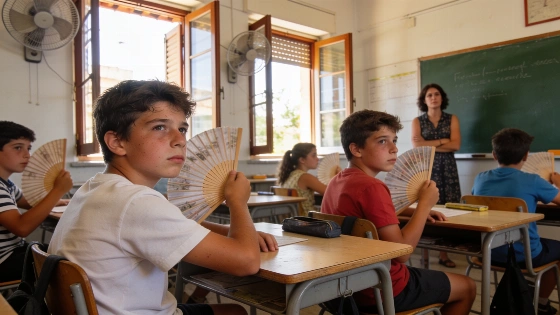
The Catalan government has set aside a separate €20 million emergency fund to install fans in 392 schools and institutes by 2026, as a stopgap until major renovations are complete.
Teachers’ unions have criticized earlier efforts. The last administration handed out thousands of fans, but they did little during heatwaves, merely moving hot air around. This summer, only 228 of 400 schools promised new fans received them, despite record heat. Frustration among teachers has prompted threats of new protests, and the Assembly of Education is preparing further action. Union and media sources have called these temporary fixes inadequate, saying they do not solve the problem of overheated classrooms.
The first 100 schools selected for upgrades were chosen based on building condition and student vulnerability. Backed by a €100 million budget, the projects are supposed to be completed by summer 2028, in line with the end of the current legislative term. The rest of the plan is less clear: there is no firm timeline or guarantee that all schools will see real improvements within five years. Local news reports say the selection process favors schools in the worst condition and those serving the most vulnerable students, but further progress depends on city governments and their budgets.
Much of the cost and responsibility falls to local municipalities. The Generalitat plans to use public-private partnerships for secondary schools, while city councils are responsible for basic schools and nurseries. The government acknowledges that its infrastructure agency, Infraestructures.cat, cannot handle the scale of the work alone. Cities are expected to pay upfront, with the Generalitat promising gradual reimbursement through 2037.
Official and media reports indicate that about 26% of Catalonia's school buildings are older than 1960/1965, making them a priority for basic energy-efficiency improvements before any air conditioning is considered. So, many schools will first get insulation or new windows instead of immediate cooling solutions.
RTVE and regional government sources
Barcelona’s city government has already tried a similar approach, using €100 million from tourist taxes to retrofit 170 schools with aerothermal systems and solar panels. But the model excludes secondary schools and depends on local funding that is not available everywhere.
Although classroom temperatures have often topped 35°C in recent years, there is no official count of how many schools already have air conditioning or how many will get it. Some temporary classrooms (“barracones”) are equipped, but most permanent buildings are not. The government considers 392 centers “thermally comfortable” simply because they are scheduled to get fans this year, a standard many teachers say falls short.
For families and teachers, the problem is immediate. Prolonged heat undermines learning and health, while widening the gap between well-funded and neglected schools. The government’s plan is ambitious on paper, but comes with caveats and depends on local cooperation and uncertain funding. For most students, relief from overheated classrooms is still a long way off. The Illa administration’s climate plan looks more like a political patch than a real fix for the growing crisis in public education.