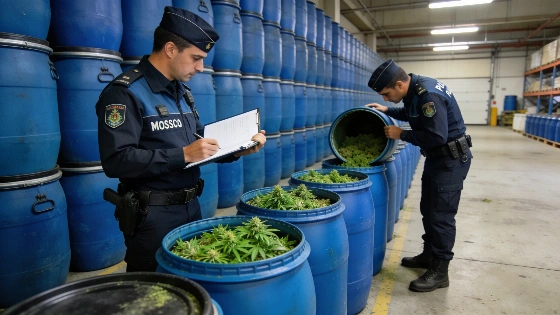
The Mossos d’Esquadra’s main drug storage in Barcelona is at breaking point. Delays in lab analysis and judicial approvals have left thousands of seized marijuana plants piling up. Police unions warn the system is now saturated.
The central drug warehouse of the Mossos d’Esquadra in Barcelona has reached a critical saturation point, with seized marijuana now exceeding the facility’s storage capacity. The Magatzem Central de Substàncies Estupefaents (MACSE), opened in Nou Barris in late 2023, was designed to solve the growing problem of storing confiscated cannabis. However, constant police raids, slow laboratory analysis, and lengthy waits for judicial destruction orders have left the system overwhelmed, according to police sources.
On average, it now takes between one and one and a half years for seized marijuana to be destroyed. The backlog has forced the Mossos to expand storage repeatedly, including a recent tender for 2,106 new high-density polyethylene barrels—over 600 more than initially planned for 2024. Despite these efforts, the warehouse is unable to keep up with the volume, especially as the MACSE now handles drugs from four major police regions: Barcelona, Metropolitana Sud, Metropolitana Norte, and Girona, as well as central services.
Police unions describe the situation as unsustainable. The Fepol union’s spokesperson, Toni Castejón, notes that the saturation is now at its maximum. The Department of Interior confirmed in January that the destruction process is slowed by three main factors: the need for a central laboratory analysis, a judicial order authorizing destruction, and the availability of an incineration plant. The main bottleneck, according to Mossos sources, is the laboratory workload, which has not kept pace with the volume of seizures. Advances in technology are expected to help, but for now, the backlog continues to grow.
Legal procedures further complicate the process. While Spanish law allows for destruction after a month if the court does not object, most officers are reluctant to proceed without explicit judicial approval. Some operations have managed to destroy marijuana on-site, but this remains the exception. The USPAC union’s Albert Palacio argues that immediate destruction should become standard protocol, provided necessary samples are preserved for court cases. Both unions call for a change in regulations to allow faster disposal and reduce the risk of storage-related issues.
Despite a 20% drop in the number of marijuana plants seized in Catalonia last year—432,000 plants, with 375 plantations dismantled—the total weight of confiscated cannabis actually rose by 34% to 9,300 kilos. This trend has intensified the storage crisis. The Mossos initially piloted the barrel system in the Metropolitana Norte region, later expanding it as the scale of the problem became clear. The original plan called for 1,500 barrels in 2024 and another 1,500 in 2025, but the reality has far outstripped these estimates.
Storage problems are not unique to the Mossos. Across Spain, police forces face similar challenges with cannabis seizures, prompting the creation of a national protocol in 2018 and an updated agreement in 2025. The guidelines recommend early judicial authorization for destruction, but also allow for disposal after a month’s notice to the court if no objection is raised—though this is rarely used in practice.
The strain on police infrastructure is part of a broader pattern of logistical challenges in Catalonia. For example, recent disruptions at Barcelona-El Prat airport, where a power outage halted flights and forced diversions, highlight how critical infrastructure can quickly become overwhelmed by unexpected events. Details on that incident can be found in this report: Barcelona airport operations disrupted by major power failure.
As Catalonia remains a major hub for marijuana cultivation in Europe, the Mossos d’Esquadra are under pressure to find lasting solutions. Until regulations are updated and laboratory capacity is increased, the central warehouse will likely remain at the edge of its limits, with practical consequences for police operations and public safety.
For context, Spain’s approach to drug destruction is shaped by both national and regional protocols, with a focus on preserving evidence for court while minimizing health and security risks. The ongoing debate centers on balancing legal safeguards with the urgent need for efficient disposal, especially as the scale of cannabis seizures continues to test the limits of police resources.