Spain’s position in North Africa is under renewed pressure. Asymmetric strategies and shifting alliances are challenging Madrid’s control over Ceuta, Melilla, and the Canary Islands. The stakes for Spanish foreign policy are rising.
Spain’s strategic foothold in North Africa is entering a period of heightened uncertainty. The longstanding balance over Ceuta, Melilla, and the Canary Islands is being tested by new forms of asymmetric power, where traditional military strength is no longer the only decisive factor. Recent developments show that smaller states, when equipped with the right leverage, can challenge even the most established powers.
The Strait of Ormuz has become a global reference point for this new reality. The ongoing standoff between the United States and Iran over this vital maritime corridor demonstrates how geography and unconventional tactics can offset conventional superiority. The situation has direct echoes in the Western Mediterranean, where Spain and Morocco are locked in a complex rivalry. Here, the contest is not defined by open conflict, but by the ability to endure pressure, manage reputational costs, and exploit moments of political transition.
Madrid’s vulnerability is compounded by several factors. The economic and demographic divide between Spain and its southern neighbors remains stark. The control of the Strait of Gibraltar, the status of Ceuta and Melilla, and the future of the Canary Islands are all points of friction. Meanwhile, the foreign policy approach of the United States under Donald Trump has reinforced Morocco’s position, aligning Rabat with Israel through the Abraham Accords and distancing Washington from its traditional European partners. This shift has left Spain exposed, with little consensus at home on how to respond.
Asymmetric strategies thrive in periods of instability. Morocco has a history of exploiting such moments, as seen during the Green March in the final days of Franco’s regime. Today, similar tactics are visible in the use of migration flows and hybrid pressure, often blurring the line between state action and organized networks. The Spanish government has pointed to the possible involvement of criminal groups, but these actors are frequently intertwined with deeper state interests in Morocco. The risk is not limited to direct confrontation; it extends to the ability to shape events during electoral cycles and moments of political uncertainty.
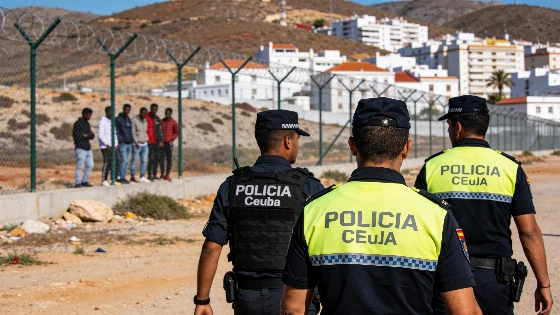
Recent events in Ceuta highlight the practical consequences of these dynamics. The city has faced repeated surges in irregular migration, overwhelming local infrastructure and testing Spain’s capacity to respond. In one notable incident, more than 40,000 people crossed the border in a single day, a situation detailed in reports such as the unprecedented influx that strained Ceuta’s emergency services. These episodes underscore how migration can be used as a tool of pressure, with significant humanitarian and political implications.
Spain’s current challenge is to adapt its foreign policy to this evolving landscape. The lack of a unified national strategy on external affairs leaves the country vulnerable to external manipulation. The stakes are high: the future of Spanish territories in North Africa, the stability of the Mediterranean, and the broader balance of power in the region all hang in the balance. As the international order becomes more fragmented, the ability to anticipate and counter asymmetric threats will be crucial for Madrid’s security and influence.
For context, Ceuta and Melilla are Spanish autonomous cities on the North African coast, surrounded by Morocco and often at the center of diplomatic tensions. The Canary Islands, located off the northwest coast of Africa, also play a key role in Spain’s maritime and migration policy. The Abraham Accords, signed in 2020, normalized relations between Israel and several Arab states, including Morocco, and have since influenced regional alliances. The Green March of 1975 was a mass demonstration orchestrated by Morocco to assert claims over Western Sahara, exploiting Spain’s political transition at the time. These historical and geopolitical factors continue to shape the risks and responses facing Spain today.