Spanish military intercepted Moroccan border agents discussing a mass entry into Ceuta days before the July 30 crisis. The government omitted this warning from its official report. The chain of command delayed action until it was too late.
Three days before thousands crossed into Ceuta, Spanish military intelligence picked up Moroccan border agents talking about a planned mass entry. The warning stayed within the Army and never reached Spain’s top command until the crisis was already underway. The government’s official report left out the most revealing details.
The key document, Sigintrep 01/2026, was prepared by the Regimiento 32 de Guerra Electrónica del Ejército de Tierra (REW 32) in Sevilla. It included two intercepted conversations in Arabic and French, where Moroccan agents mentioned orders from the Fuerzas Armadas Reales de Marruecos to get ready for a possible mass crossing into Ceuta during the Throne Day celebrations. The agents were told to stay at their posts and stop anyone trying to swim across, even if it meant puncturing flotation devices.
According to Reuters, on July 29, Spain's CNI sent a written warning to Moroccan intelligence and Madrid about plans circulating on social media to storm Ceuta during the Throne Day celebrations.
Despite the urgency, the intelligence sat with the Army for almost three days. Only on the morning of July 30 did the Jefe del Estado Mayor de la Defensa (Jemad) get the report and inform Minister Margarita Robles. By then, the border was already overwhelmed. The government’s public report included only the final point, which vaguely warned of a likely mass entry, but left out the intercepted conversations and the timeline showing the delay.
Sources cited by EL MUNDO say the original note was drafted on July 27 and stayed within the Army until the day of the incident. Before it was sent to the Centro de Inteligencia de las Fuerzas Armadas (CIFAS), the raw intercepts were removed, leaving just a cleaned-up summary. The official alert went out when it was already too late to act.
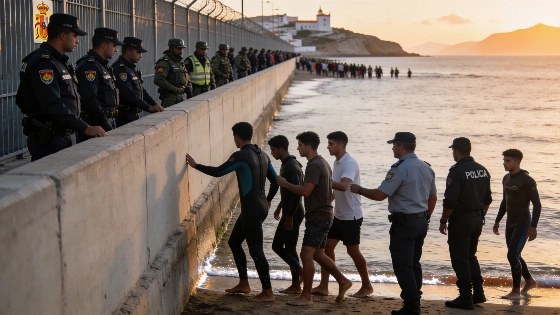
The consequences were immediate. On July 30, only nine Guardia Civil officers were at the border—five on land and four from the GEAS diving unit, including their chief, who was on medical leave. As the crossing began, the local command had to close its headquarters and send everyone to the border, but the response was quickly overwhelmed.
Declassified documents confirm that the CNI's warning reached civil authorities in Ceuta and the Guardia Civil, but not the Ministry of Defense. This gap in the information chain is now central to debates about where the breakdown in Spain's crisis response occurred.
Meanwhile, the CNI had already warned Moroccan intelligence in writing on July 29 about the risk of a mass crossing the next day. Morocco, fully aware, did not do enough to stop the surge. This matches earlier reports of Moroccan forces standing by during the crisis, as detailed in previous coverage.
The Regimiento de Transmisiones 32, which handles specialized military communications, detected the threat. But the failure to escalate the warning in time exposed a serious gap in Spain’s border security. The government’s decision to release only a partial version of the intelligence report has led to accusations of a cover-up and left open questions about who was responsible.
This episode shows a systemic failure in Spain’s crisis response. The intelligence was there, but bureaucracy and selective disclosure left the border exposed. Leaving out key evidence from the official story has damaged public trust and points to a deeper reluctance to address operational failures at the top. Unless Spain’s security institutions deal with these lapses openly, the risk of another breakdown remains.