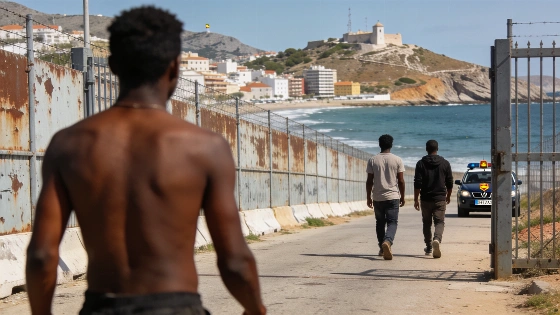
A DYM poll finds widespread doubts about the Government's response in Ceuta. More than half of Socialist voters question how the crisis was handled and whether enough resources were used.
The Government's handling of the Ceuta crisis is failing to convince many Socialist voters. A survey by Instituto DYM for 20minutos found that 52.7% of PSOE voters doubt whether enough resources are being used to resolve the migration crisis quickly. Across the full sample, the criticism is stronger: 69.7% say the Government is not putting in enough resources.
The poll also challenges the Government's claim that the mass crossing from Morocco on 30 July could not have been predicted with the information available at the time. Overall, 58.1% of respondents believe the episode could have been foreseen. That figure rises to 81.6% among PP voters and 82.9% among Vox voters.
Prime Minister Pedro Sánchez said Morocco’s border control had failed, while Spain also announced a €9 million investment to reinforce the Tarajal maritime border infrastructure.
Socialist voters are more divided than opposition voters. They still do not give the Executive a clear defence. Only 37.9% agree that the scale and likelihood of the event could not have been predicted. Another 36.3% believe it could have been anticipated. Among Sumar voters, 39.8% reject the idea that the episode could have been predicted, compared with 26.1% who say it was foreseeable.
The argument over preparation is matched by dissatisfaction with the response after the arrivals. The Government receives an average score of 2.6 out of ten for its handling of the crisis. That is one point below its rating during the 2021 migration crisis, when around 8,000 people crossed the border irregularly from Morocco.
Even the Government's own voters give it a failing mark.
On 18 September, Spanish police began clearing migrants from Ceuta’s beaches and moving some of them into temporary accommodation. Estimates of the number still in Ceuta later diverged sharply: Madrid cited about 10,000 people, while local authorities put the figure closer to 13,000.
PSOE voters rate the response at 4.4 out of ten. Sumar voters give it 4.9. Views on resources are just as uncomfortable for the ruling party. Some 52.7% of Socialist voters say the Government is not putting enough resources into a quick solution, while only 35.8% believe the deployment is sufficient. Sumar voters are more evenly split, with 47.9% criticising the level of resources and 43.9% defending it.
The opposition parties do not emerge as clear beneficiaries of public dissatisfaction. Respondents give the PP 3.3 out of ten and Vox 3.4. Each party is approved only by its own supporters, who give them 5.5 and 7.6 respectively. Sumar receives 2.5 across the sample and passes only among its own voters, with a narrow 5.5.
The poll also finds strong public support for explanations that link the July arrivals to policies affecting migrants in Spain. Some 67% say the benefits received by immigrants living in the country influenced the mass entry either "a lot" or "quite a lot". Only 13.8% attach little or no importance to that factor. The April extraordinary regularisation approved by the Government is also seen as relevant by 63.2% of respondents. Another 15.7% reject that connection.
The figures add to the scrutiny already facing the Government's account of the episode. A previous Ceuta report described the parliamentary pressure on Margarita Robles and Fernando Grande-Marlaska after questions about intelligence warnings and the official response.
The size of the crisis remained disputed beyond the survey. Reporting by RTÉ and Reuters cited sharply different estimates of the July influx. Early Interior Ministry figures put it at 50,000-60,000 people, while local authorities gave higher estimates. The gap shows how difficult it has been to establish how many people arrived and how many later remained. RTÉ also reported that the Interior Ministry counted about 5,000 people still in Ceuta by the end of August. Local authorities estimated between 9,000 and 10,000.
Reuters reported that the September operation used crowd-control equipment as police cleared beach areas and moved people towards temporary facilities. The operation was part of a wider effort by Spanish authorities and Morocco to contain and redistribute those who had entered. New attempted mass crossings in mid-September were reportedly intercepted in part by Moroccan forces before reaching the border.
The survey matters because the problem is not limited to the Government's low overall rating. It has failed to persuade a majority that it prepared for the crossing or that it is using enough resources afterwards. With 52.7% of Socialist voters rejecting the response as adequate and only 37.9% accepting the Government's account of whether the episode could have been predicted, the poll shows that Ceuta has become a credibility problem inside the ruling electorate as well as among its opponents.