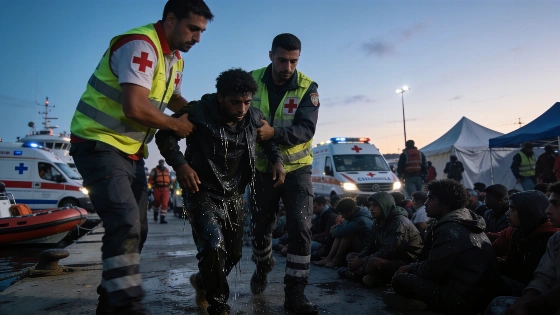
Ceuta faces mounting pressure after 47 migrants reached its shores in a single day. Local authorities warn of a system collapse as arrivals overwhelm emergency and reception services. The crisis exposes urgent gaps in coordination.
Ceuta’s migration crisis has intensified, with 47 people intercepted off the coast in just a few hours, pushing local reception systems to the brink. Emergency teams from Salvamento Marítimo and Cruz Roja Española rescued groups of migrants attempting to swim from Morocco, as maritime patrols struggled to keep up with the volume of arrivals. The city’s president, Juan Jesús Vivas, has described the situation as a “collapse” and called for a unified command to manage the escalating emergency.
According to humanitarian sources, the LS Hipatia vessel from Cruz Roja Española worked alongside the Guardia Civil and Salvamento Marítimo in two consecutive operations after border patrols were overwhelmed. Eight migrants, mainly from Morocco and Algeria, were found in the water and brought to the Muelle de España, while another 39 were rescued by Salvamar Atria. All were transferred to the National Police and then to the Centro de Estancia Temporal de Inmigrantes (CETI), which is now operating far beyond its capacity due to the surge in arrivals.
Authorities report that more than 2,000 adult migrants are currently housed in Ceuta’s emergency facilities, with the CETI unable to accommodate the influx. The city has seen over 1,000 new arrivals in just one week, many of whom entered by swimming around both border perimeters. The recent spike coincides with a Supreme Court ruling on July 8 that restricts immediate returns for those who cross by sea, reserving “hot returns” only for those who breach physical border barriers such as fences.
President Vivas emphasized the need for urgent coordination, arguing that the legal framework is secondary to the immediate necessity of establishing a single command structure. He acknowledged that legal reforms could have been addressed earlier, but pointed to the current legislative gridlock. The crisis has also affected the management of unaccompanied minors, a responsibility that falls partly on the autonomous city itself.
On the ground, the overflow at the CETI has forced many migrants to sleep outdoors or set up makeshift camps nearby. José Miguel Morales, director of Sur Acoge, noted that the number of migrants outside the center nearly matches those inside, and local media have reported at least four drownings among those attempting the crossing. Morales stressed that these summer surges are not new, and called for a permanent scaling-up of social and reception services rather than repeated emergency responses.
This latest escalation follows a pattern seen in previous years, where Ceuta experiences sharp increases in sea arrivals during the summer months. For further context on how local emergency teams have responded to similar surges, see this recent report on the ongoing challenges faced by Ceuta’s Red Cross teams during peak migration periods.
Ceuta’s unique position as a Spanish enclave bordering Morocco makes it a focal point for irregular migration into Europe. The CETI, designed as a temporary holding facility, has repeatedly struggled with overcrowding during peak periods. Spanish law limits the duration of stays, but bottlenecks in processing and onward transfers often leave migrants in limbo. The Supreme Court’s recent decision has added complexity to border management, as authorities can no longer immediately return those who swim across, increasing the administrative and humanitarian burden on local services. The situation in Ceuta highlights the ongoing challenges Spain faces in balancing border security, legal obligations, and humanitarian response at one of its most sensitive frontiers.