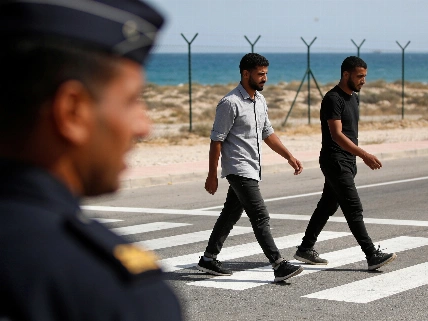
Ceuta experienced a surge of Moroccan youths crossing the border on Thursday. The influx overwhelmed local resources and exposed gaps in border security. Police struggled to contain the coordinated movement.
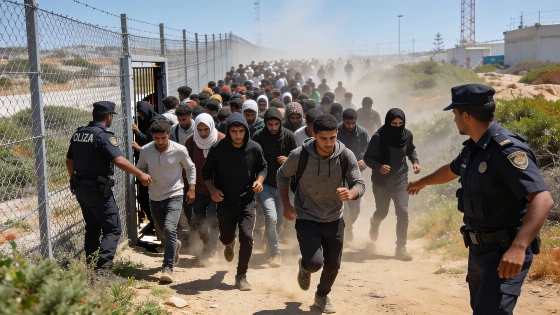
Ceuta was thrust into a state of tension on Thursday as thousands of young Moroccans crossed the border from Castillejos in a coordinated mass movement. The sudden influx, which unfolded in broad daylight, quickly overwhelmed the city’s capacity to respond and exposed the limits of both Spanish and Moroccan border controls.
According to EFE, large groups of young people, many arriving by car or motorcycle, gathered near the border fence separating Morocco and the Spanish enclave. With Moroccan police temporarily absent from key points, hundreds managed to breach the protective barriers and enter Ceuta. Witnesses described how Moroccan auxiliary forces withdrew as the crowds advanced, allowing the flow of people to continue largely unchecked.
The timing of the incident coincided with Morocco’s Fiesta del Trono, but security officials interviewed by EFE said they were unaware of any specific reason for the mass crossing. By midday, thousands had converged on the border perimeter, moving on foot, by motorcycle, and by car from various parts of Castillejos. The crowd included not only young men but also families, women, and children, all advancing together toward Spanish territory.
While Moroccan police attempted to establish control at some access points, many groups bypassed these efforts by moving through the hills surrounding the border. Dozens reached the breakwater and wire fence without encountering significant resistance. Simultaneously, other groups attempted to swim around the border, echoing previous incidents where migrants entered Ceuta by sea. Some walked parallel to the Spanish fence, seeking alternative entry points.
At one location, a small group of Moroccan officers tried to block a gap dug beneath the fence, but most of the group had already crossed. Despite attempts to stem the flow, dozens more continued to approach and pass through the same opening. Several individuals were detained during these efforts, but the majority managed to reach Spanish soil.
Roughly 500 meters from the main crossing, a dozen Moroccan agents maintained a checkpoint, yet the steady stream of arrivals from surrounding areas continued. The result was a sustained and largely uncontrolled entry of migrants into Ceuta, with thousands crossing on foot via the breakwater, as confirmed by EFE. These arrivals added to the 1,500 to 2,000 people who had entered the city by swimming over the previous ten days, a situation that has already stretched Ceuta’s reception and support services to their limits.
Security officials reiterated their lack of information regarding the motives behind the mass movement, despite its overlap with a major Moroccan holiday. Meanwhile, police unions Sindicato Unificado de Policía (SUP) and Jupol criticized Moroccan authorities for failing to prevent the crossings, stating that Moroccan forces were no longer detaining anyone and describing the situation as a “total collapse” for Spanish border agents.
This latest episode follows a pattern of increased migrant arrivals in Ceuta, with local emergency services and aid organizations repeatedly tested by the scale and frequency of such events. As highlighted in a recent report, Red Cross teams have been providing urgent assistance to exhausted young migrants reaching Ceuta’s shores, underscoring the ongoing humanitarian and logistical challenges facing the enclave.
Ceuta’s unique position as a Spanish territory bordering Morocco has long made it a focal point for migration flows from North Africa to Europe. The city’s border infrastructure, including fences and breakwaters, is designed to deter unauthorized crossings, but recent events have shown that determined groups can still find ways through. The repeated mass entries highlight the need for coordinated action between Spanish and Moroccan authorities, as well as sustained support for local services tasked with managing the humanitarian impact.